





Research library —— Digital dentistry
Innovation Backed by Peer-Reviewed Publications
Materials
Technology
Clinical Possibilities
Discover the research supporting LuxCreo’s approach to direct-print digital dentistry
PUBLICATIONS
RESEARCH THEMES
EVIDENCE LIBRARY
Why the work matters
Driven by Science.
Built for You.
The best innovations don’t just sound good. They hold up under investigation.
That's why LuxCreo continues to invest in research and education alongside clinicians and researchers around the world.
We now have an independent body of scientific work that explores the materials and technologies behind direct-print digital dentistry, and what they could mean for predictability, efficiency, customization, and patient care.
Publication index
See the Evidence
PROGRESS IN ORTHODONTICS
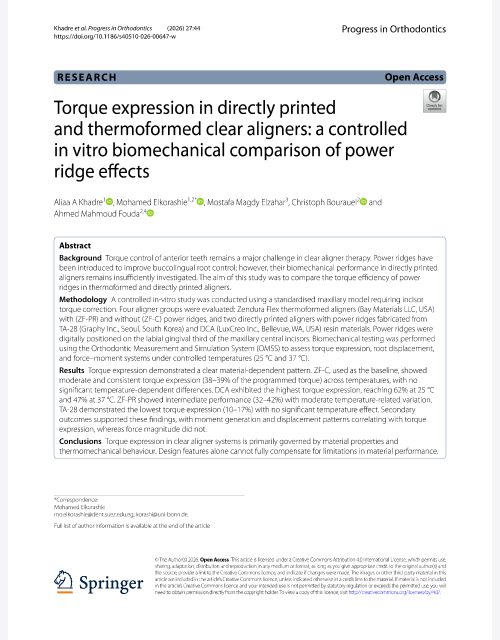
Torque expression in directly printed and thermoformed clear aligners: a controlled in vitro biomechanical comparison of power ridge effects
This controlled in vitro study compared torque expression in Zendura Flex thermoformed aligners with and without power ridges and directly printed TA-28 and LuxCreo DCA aligners with power ridges. Testing used the Orthodontic Measurement and Simulation System (OMSS) at 25 °C and 37 °C. DCA exhibited the highest torque expression among the tested groups, reaching 62% at 25 °C and 47% at 37 °C. Within the limitations of this in vitro study, the findings indicate that torque expression depends primarily on material properties and thermomechanical behavior, and that effective torque delivery requires an appropriate force–moment system rather than force magnitude alone.
PROGRESS IN ORTHODONTICS
Torque expression in directly printed and thermoformed clear aligners: a controlled in vitro biomechanical comparison of power ridge effects
This controlled in vitro study compared torque expression in Zendura Flex thermoformed aligners with and without power ridges and directly printed TA-28 and LuxCreo DCA aligners with power ridges. Testing used the Orthodontic Measurement and Simulation System (OMSS) at 25 °C and 37 °C. DCA exhibited the highest torque expression among the tested groups, reaching 62% at 25 °C and 47% at 37 °C. Within the limitations of this in vitro study, the findings indicate that torque expression depends primarily on material properties and thermomechanical behavior, and that effective torque delivery requires an appropriate force–moment system rather than force magnitude alone.
JOURNAL OF FUNCTIONAL BIOMATERIALS
Static and Dynamic Mechanical Properties of 3D-Printable Aligner Resins: An In Vitro Study with FTIR Chemical Characterization
This in vitro study compared the flexural behavior, stress relaxation, and chemical profiles of five Class IIa-certified resins designed for direct-printed orthodontic aligners. At 37°C, DCA demonstrated a balanced performance profile, combining high stiffness and load-bearing capacity with strong unloading stiffness and relatively slow stress relaxation.

JOURNAL OF FUNCTIONAL BIOMATERIALS
Static and Dynamic Mechanical Properties of 3D-Printable Aligner Resins: An In Vitro Study with FTIR Chemical Characterization
This in vitro study compared the flexural behavior, stress relaxation, and chemical profiles of five Class IIa-certified resins designed for direct-printed orthodontic aligners. At 37°C, DCA demonstrated a balanced performance profile, combining high stiffness and load-bearing capacity with strong unloading stiffness and relatively slow stress relaxation.
SCIENTIFIC REPORTS
Biocompatibility of a novel directly printed orthodontic aligner at variable material thicknesses
This study evaluated whether LuxCreo's standardized 20‑minute UV post‑cure is sufficient to achieve biocompatibility in direct‑printed appliances made with DCA resin. Results showed that the workflow produced dimensionally accurate, non‑cytotoxic appliances up to 6 mm thick without requiring additional post‑curing, supporting its use for safe clinical applications.
SCIENTIFIC REPORTS
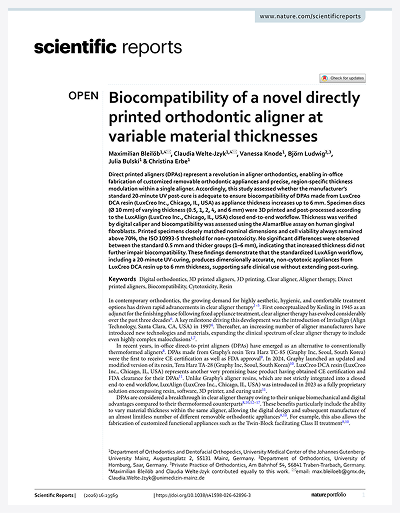
Biocompatibility of a novel directly printed orthodontic aligner at variable material thicknesses
This study evaluated whether LuxCreo's standardized 20‑minute UV post‑cure is sufficient to achieve biocompatibility in direct‑printed appliances made with DCA resin. Results showed that the workflow produced dimensionally accurate, non‑cytotoxic appliances up to 6 mm thick without requiring additional post‑curing, supporting its use for safe clinical applications.
BMC ORAL HEALTH
Automated micro‑CT quantification of clear aligner fit: a pilot comparison of manufacturing processes
This in vitro pilot study compared the fit accuracy of nine aligners produced using three manufacturing methods, including LuxCreo direct printing and Invisalign thermoforming. No statistically significant differences in fit accuracy were found between the 3D‑printed and thermoformed aligners, providing preliminary support for direct printing as a faster, potentially more cost‑effective manufacturing approach.

BMC ORAL HEALTH
Automated micro‑CT quantification of clear aligner fit: a pilot comparison of manufacturing processes
This in vitro pilot study compared the fit accuracy of nine aligners produced using three manufacturing methods, including LuxCreo direct printing and Invisalign thermoforming. No statistically significant differences in fit accuracy were found between the 3D‑printed and thermoformed aligners, providing preliminary support for direct printing as a faster, potentially more cost‑effective manufacturing approach.
PROGRESS IN ORTHODONTICS
Force comparison between Perfitalign 4D aligners and thermoformed aligners for mandibular incisor retraction: an in vitro study
To quantitatively compare the orthodontic forces exerted during mandibular incisor retraction by 4D aligners and thermoformed aligners over a 60‑hour dynamic monitoring period, assess tooth movement trends, and investigate the effects of shape‑memory properties on force characteristics. 4D aligners exhibited significant force recovery after thermal reactivation, though the recovery degree slightly decreased with repeated activations. Vertical forces markedly fluctuated but increased after thermal reactivation.

PROGRESS IN ORTHODONTICS
Force comparison between Perfitalign 4D aligners and thermoformed aligners for mandibular incisor retraction: an in vitro study
To quantitatively compare the orthodontic forces exerted during mandibular incisor retraction by 4D aligners and thermoformed aligners over a 60‑hour dynamic monitoring period, assess tooth movement trends, and investigate the effects of shape‑memory properties on force characteristics. 4D aligners exhibited significant force recovery after thermal reactivation, though the recovery degree slightly decreased with repeated activations. Vertical forces markedly fluctuated but increased after thermal reactivation.
PLOS ONE
Bond strength of thermoformed and 3D‑printed aligners with universal primer versus one‑step aligner adhesive with and without sandblasting: An in vitro study
This study compared bond strength and failure patterns across six aligner materials using different adhesive protocols, with and without sandblasting. Results indicated that a universal primer and orthodontic adhesive provided more consistent bonding for 3D‑printed aligners, while sandblasting further improved adhesion to DCA resin appliances.

PLOS ONE
Bond strength of thermoformed and 3D‑printed aligners with universal primer versus one‑step aligner adhesive with and without sandblasting: An in vitro study
This study compared bond strength and failure patterns across six aligner materials using different adhesive protocols, with and without sandblasting. Results indicated that a universal primer and orthodontic adhesive provided more consistent bonding for 3D‑printed aligners, while sandblasting further improved adhesion to DCA resin appliances.
POLYMERS
Water Desorption Governs Glass Transition Recovery in Aligner Polymers
This study examined how water exposure affected the viscoelastic properties and glass transition temperature (Tg) of four orthodontic polymers with different material structures. The crosslinked LuxCreo resin showed one of the smallest Tg changes among the materials tested, with a shift of just −0.77°C, indicating strong stability under water exposure.

POLYMERS
Water Desorption Governs Glass Transition Recovery in Aligner Polymers
This study examined how water exposure affected the viscoelastic properties and glass transition temperature (Tg) of four orthodontic polymers with different material structures. The crosslinked LuxCreo resin showed one of the smallest Tg changes among the materials tested, with a shift of just −0.77°C, indicating strong stability under water exposure.
JOURNAL OF CLINICAL AND EXPERIMENTAL DENTISTRY
Biocompatibility of Direct 3D‑Printed Clear Aligner Resins: A Comparative In Vitro Cytotoxicity Analysis
This study compared four commercially available materials used for directly 3D‑printed clear aligners, evaluating tensile strength, flexural behavior, and surface hardness. The results suggest that LuxCreo’s material demonstrated favorable flexibility, indicating potential advantages in applications where patient comfort is a priority.

JOURNAL OF CLINICAL AND EXPERIMENTAL DENTISTRY
Biocompatibility of Direct 3D‑Printed Clear Aligner Resins: A Comparative In Vitro Cytotoxicity Analysis
This study compared four commercially available materials used for directly 3D‑printed clear aligners, evaluating tensile strength, flexural behavior, and surface hardness. The results suggest that LuxCreo’s material demonstrated favorable flexibility, indicating potential advantages in applications where patient comfort is a priority.
ASIAN PACIFIC ORTHODONTIC SOCIETY
Assessment of active memory of photo‑curable resins for LuxCreo DCA direct‑printed 3D Aligners
In a materials study led by Dr. Jean‑Marc Retrouvey, researchers evaluated two photo‑curable resins developed for LuxCreo’s direct‑printed aligners: DCA and DCA Plus.
- Thermomechanical stability – how the materials respond to changes in temperature and mechanical stress
- Shape‑memory behavior – the ability of the material to return toward its intended shape after deformation
- Force retention and recovery – how effectively orthodontic forces are maintained over time and restored after changes in the material’s shape
Overall, the results demonstrated promising performance from the shape‑memory materials, highlighting their potential advantages over conventional thermoforming plastics and supporting the use of direct‑printed aligners for more predictable orthodontic applications.
ASIAN PACIFIC ORTHODONTIC SOCIETY
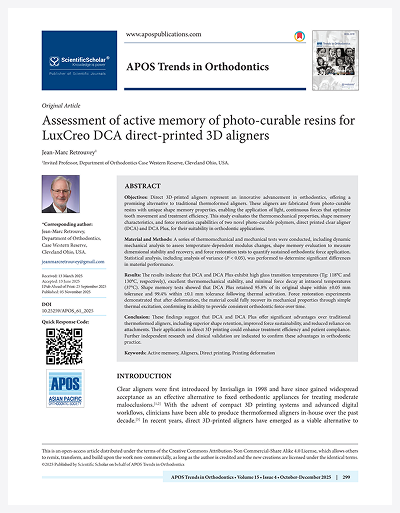
Assessment of active memory of photo‑curable resins for LuxCreo DCA direct‑printed 3D Aligners
In a materials study led by Dr. Jean‑Marc Retrouvey, researchers evaluated two photo‑curable resins developed for LuxCreo’s direct‑printed aligners: DCA and DCA Plus.
- Thermomechanical stability – how the materials respond to changes in temperature and mechanical stress
- Shape‑memory behavior – the ability of the material to return toward its intended shape after deformation
- Force retention and recovery – how effectively orthodontic forces are maintained over time and restored after changes in the material’s shape
Overall, the results demonstrated promising performance from the shape‑memory materials, highlighting their potential advantages over conventional thermoforming plastics and supporting the use of direct‑printed aligners for more predictable orthodontic applications.
ASIAN PACIFIC ORTHODONTIC SOCIETY
Comparative evaluation of mechanical properties of directly 3D‑printed clear aligner materials
This study compared four commercially available materials for direct 3D‑printed clear aligners, evaluating tensile behavior, flexural properties, and surface hardness. LuxCreo demonstrated the highest elongation at break at 118.4 ± 10.7%, indicating greater flexibility and ductility among the materials tested.

ASIAN PACIFIC ORTHODONTIC SOCIETY
Comparative evaluation of mechanical properties of directly 3D‑printed clear aligner materials
This study compared four commercially available materials for direct 3D‑printed clear aligners, evaluating tensile behavior, flexural properties, and surface hardness. LuxCreo demonstrated the highest elongation at break at 118.4 ± 10.7%, indicating greater flexibility and ductility among the materials tested.
Start a conversation
Have a Question or Inquiry?
Want to learn about a publication? Interested in collaborating on research? Have a question about the science?
We're here to talk.
Book a Consultation
Our sales team will contact you within 24 hours.