







Are direct-print aligners FDA approved?
Not technically — and that's actually the more precise, more reassuring answer. Clear aligners go through FDA clearance, not approval. Here's exactly what that means, what LuxCreo cleared, and why its integrated workflow is a distinct clearance from a materials-only one.
"FDA approved" is the wrong question — here's the right one
Clear aligners, including direct-printed ones, aren't put through FDA "approval." They go through FDA 510(k) clearance as Class II medical devices — a different, appropriate pathway for this device category. LuxCreo's Direct Clear Aligner Material (DCA), the resin used in its direct-print workflow, holds FDA Class II 510(k) clearance for an aligner indication. LuxCreo positions itself as among the first companies with an FDA-cleared, vertically integrated direct-print aligner workflow, meaning its own printer, software, and material are cleared and validated together as one system, rather than a materials-only clearance paired with third-party hardware, or the traditional model-and-thermoform approach most aligner brands still use.
FDA cleared vs. FDA approved
These terms get used interchangeably in casual conversation, but the FDA treats them as two different regulatory pathways tied to two different risk classifications. Neither one is "better" — each device type is assigned the pathway that fits its risk level.
What clear aligners go through
- Applies to most Class II, moderate-risk devices
- Requires showing substantial equivalence to an already legally-marketed device
- The standard, appropriate pathway for clear aligner systems, including LuxCreo's
A different pathway, for different devices
- Reserved for higher-risk, Class III devices
- Requires independent clinical evidence of safety and effectiveness
- Not the pathway the FDA assigns to clear aligner devices
How LuxCreo's integrated workflow got cleared
Five years of workflow development
LuxCreo built its direct-print aligner workflow in collaboration with orthodontists, dentists, and dental labs — developing the printer, resin, and software as one integrated system rather than a single cleared component bolted onto existing equipment.
LuxAlign® launches as an FDA Class II 510(k)-cleared workflow
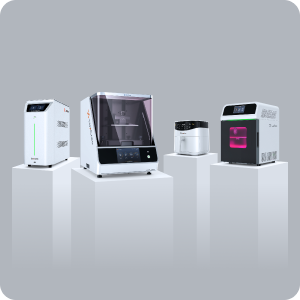
LuxCreo introduced the end-to-end system: the iLux Pro Dental chairside DLP printer, LuxAlign® design software, Direct Clear Aligner Material (DCA), and iLuxCure Pro post-processing. LuxCreo describes this as among the first FDA-cleared, vertically integrated direct-print clear aligner workflows, meaning hardware, software, and material cleared together as one system, replacing the model-and-thermoform sequence entirely.
Same-day production becomes clinically real
The cleared workflow enables aligner delivery in as little as two hours from an oral scan, according to LuxCreo, compared with the days-to-weeks turnaround typical of outside thermoforming labs.
Strategic backing from Angelalign
LuxCreo has since taken a strategic investment from Angelalign, a major player in the broader clear aligner industry — outside validation on top of the regulatory clearance.
Clearance you can put your name behind
Material safety standards
DCA resin, as an FDA Class II 510(k)-cleared material, is reviewed against biocompatibility and mechanical performance standards for intraoral, removable orthodontic use.
An answer, not a hedge
When a patient asks "is this FDA approved," you can give the accurate answer — FDA cleared, Class II, 510(k) — instead of an oversimplified yes that a well-informed patient might question.
A workflow built on the clearance, not around it
The clearance covers the material used across LuxCreo's direct-print workflow, not a single component retrofitted to an unrelated pathway.
Regulatory questions, answered directly
Are direct-print aligners FDA approved?
Not technically. "FDA approved" refers to a different regulatory pathway (Premarket Approval), typically used for higher-risk devices. Clear aligners, including LuxCreo's direct-printed aligners, go through FDA 510(k) clearance as Class II medical devices instead — the standard, appropriate pathway for this device category.
Is LuxCreo's direct-print aligner material FDA cleared?
Yes. LuxCreo's Direct Clear Aligner Material (DCA) holds FDA Class II 510(k) clearance for an aligner indication. LuxCreo states this makes it among the first FDA-cleared, vertically integrated direct-print aligner workflows, combining its own printer, software, and material as one cleared system, rather than a materials-only clearance paired with third-party hardware or the traditional model-and-thermoform approach.
What is the difference between FDA cleared and FDA approved?
510(k) clearance applies to most moderate-risk, Class II devices and requires showing substantial equivalence to an existing legally-marketed device. FDA approval (PMA) is a more intensive pathway generally reserved for higher-risk, Class III devices. Clear aligners fall into the 510(k)-cleared category.
When did LuxCreo receive its FDA clearance for direct-print aligners?
LuxCreo announced its FDA Class II 510(k) clearance and launched its end-to-end direct-print aligner workflow in April 2023 at the AAO annual session, following approximately five years of development with orthodontists, dentists, and dental labs.
Get the regulatory detail in writing
A LuxCreo specialist can walk through the clearance documentation, material specifications, and how the regulatory story fits into your patient consent conversations.
Still deciding?
This page describes the FDA regulatory pathway in general terms for informational purposes and reflects information published by LuxCreo and reported by industry press at the time of writing. Other companies also hold FDA 510(k) clearances for direct-print aligner materials; LuxCreo's claim here refers specifically to its own printer, software, and material being cleared together as one integrated workflow. This page is not legal or regulatory advice. For current, authoritative clearance documentation, consult the FDA 510(k) database or contact LuxCreo directly.