





Top Dental 3D Printer Brands & Market Leaders: Complete 2025 Comparison Guide
Table of Contents
- Understanding the Dental 3D Printer Market Leadership
- The Six Market Leaders Dominating Dental 3D Printing
- Technology Paradigm Shifts: Direct-Print vs. Traditional Workflows
- Detailed Brand Comparisons & Specifications
- ROI Analysis & Cost-Per-Aligner Benchmarks
- Clinical Evidence & Case Studies
- Selection Framework & Recommendations
Understanding the Dental 3D Printer Market Leadership
The dental 3D printing market reached $158.6 million in 2024 and is projected to grow from $174.1 million in 2025 to $345.2 million by 2032, representing a compound annual growth rate (CAGR) of 10.3%. This explosive expansion reflects fundamental shifts in how dental practices and orthodontic laboratories manufacture aligners, models, surgical guides, and restorations.
The market consolidation pattern reveals a striking competitive dynamic. Stratasys and 3D Systems collectively maintain 20-35% market share, while the remaining 65-80% divides among regional players and emerging innovators. This fragmentation creates opportunity for disruptive technology providers—a position LuxCreo has capitalized on by introducing the world’s first FDA-cleared direct-print clear aligner system in 2022, fundamentally challenging traditional manufacturing paradigms.
North America dominates with 39.6% global market share ($62.8 million in 2024), driven by advanced dental infrastructure, high patient demand for cosmetic orthodontics, sophisticated reimbursement frameworks, and concentrated investment in digital dentistry innovation. Europe holds the second position with sustained moderate growth fueled by increasing digital dentistry adoption and demand for personalized dental solutions.
Why Market Leadership Matters for Practitioners
Understanding which brands lead the market provides crucial context for purchasing decisions. Market leaders typically offer:
- Proven technology validated across thousands of installations
- Mature ecosystems with extensive material libraries and software integration
- Robust support infrastructure including regional service centers and response guarantees
- Clinical evidence demonstrating consistent outcomes across diverse applications
- Vendor stability reducing risk of equipment obsolescence or discontinued supplies
However, market leadership doesn’t always equal optimal performance for your specific needs. Established players may prioritize high-volume laboratory applications, while emerging leaders like LuxCreo specifically engineer solutions for chairside orthodontic practices seeking same-day delivery capabilities.
The Six Market Leaders in Dental 3D Printing
1. Stratasys: Enterprise-Scale Manufacturing Pioneer
Market Position: Top 3 global dental 3D printing vendor with 20-35% market share
Core Technology: PolyJet multi-material jetting technology
Flagship Product: J5 DentaJet System
Key Strengths:
- Multi-material simultaneous printing enabling full-color, monolithic dentures with multiple tooth and base shades in a single build
- Superior esthetic outcomes rivaling traditional denture manufacturing
- Industrial-scale capacity for high-volume dental laboratory operations
- Unattended printing capabilities reducing labor dependency
- TrueDent biocompatible resin delivering exceptional durability and functional performance
- 350% year-over-year growth in dental market adoption (as of late 2025)
Build Volume: Large-format platform optimized for denture production
Best For: High-volume dental laboratories specializing in denture fabrication and multi-material applications requiring exceptional esthetics
Limitations:
- High equipment cost ($50,000+ typical investment)
- Not optimized for direct clear aligner printing
- Complex material handling and post-processing
- Larger footprint unsuitable for chairside applications
Clinical Evidence: Prime Dental Laboratory reports reducing denture production from 12 hours (traditional analog) to 6 hours (3D printing), with further 1-hour reductions through post-processing optimization.
2. 3D Systems: Diversified Industrial Leader
Market Position: Top 3 dental 3D printing vendor globally with substantial market share
Core Technologies: Multiple platforms including DLP, SLS, and binder jetting
Key Strengths:
- Comprehensive portfolio spanning dental models, surgical guides, orthodontic applications, and restorations
- Extensive material library supporting 100+ dental-specific resins
- Healthcare Solutions division dedicated to dental applications
- Strong distribution channels and established relationships with dental labs
- sCultpeo and NextDent platforms providing flexibility across applications
- Proven reliability in high-volume laboratory environments
Best For: Large dental laboratories requiring diverse multi-application capabilities and maximum material flexibility
Limitations:
- No direct clear aligner printing capability (models only, requiring thermoforming)
- Higher equipment costs than emerging competitors
- Complex operational requirements unsuitable for small practices
- Slower innovation cycles compared to specialized dental companies
3. LuxCreo: Direct-Print Innovation Disruptor
Market Position: Emerging leader with rapidly expanding market presence following FDA clearance
Core Technology: DLP (LEAP™ proprietary platform) with Digital Polishing™ capability
Flagship Products: iLux Pro Dental Printer and 4D Aligner™ System
Revolutionary Differentiation:
- World’s first and only FDA-cleared direct-print clear aligner system (FDA Class II 510(k) clearance obtained January 2023)
- Direct aligner printing eliminates thermoforming entirely, reducing production time from weeks to 2-3 hours
- ActiveMemory™ shape-memory polymer enables thermoreversible recovery through immersion in >60°C water
- Digital Polishing™ delivers glass-like transparency (80% higher clarity than competitors) without manual polishing
- Variable thickness AI-driven design enabling precise force zoning and reduced attachment requirements
- 1-Click automation workflow (LuxDesign + LuxFlow) eliminating complex technical decisions
Technical Specifications:
- Build Volume: 192 × 108 × 200 mm
- Resolution: 3840 × 2160 ppi with 50 µm pixel pitch
- Batch Capacity: Up to 80 aligners per print
- Dimensional Accuracy: 99%
- Print Success Rate: 99%
- Material Support: 23+ validated dental resins (proprietary + third-party)
- Applications: 11+ including aligners, retainers, splints, models, surgical guides, dentures, crowns, implant guides, impressions
Cost Analysis:
- Complete System Price: ~$25,000-27,000 (printer + software + post-processing)
- Cost Per Aligner: $12.47 (19% less than $15.87 thermoforming cost)
- Labor Per Aligner: 1.5 minutes active time (vs. 5.5 minutes thermoforming)
- Annual Savings (100 cases/month): $40,800 in direct cost reduction
ROI Timeline: 3-6 months typical payback period
Clinical Evidence:
- Dr. Bill Layman: “I wish I researched LuxCreo before buying SprintRay. I now own two LuxCreo machines.”
- Dr. Mike Pham: “LuxDesign saves my practice 60-75% labor costs vs. traditional workflows and significantly shortens patient wait times.”
- Dr. Neil Warshawsky: “4D Aligners are the ‘holy grail’—superior fit accuracy, better torque control, fewer attachments required.”
Support Quality: Industry-leading 99% response rate within 60 minutes with omni-channel assistance (phone, email, remote diagnostics, on-site)
Best For:
- Orthodontic practices pursuing same-day aligner delivery
- Clinics prioritizing labor cost reduction and workflow efficiency
- Practices seeking competitive differentiation through direct-print capability
- High-volume dental labs requiring disruptive production capacity
4. SprintRay: Established Chairside Excellence
Market Position: Leader in chairside dental 3D printing with widespread practitioner adoption
Core Technology: DLP (Optical Panel™ technology)
Flagship Product: SprintRay Pro 2 and emerging SprintRay MIDAS
Key Specifications (Pro 2):
- Build Volume: 18.8 × 10.5 × 20 cm
- Resolution: 35 µm XY
- Print Speed: 30-40 minutes for models (50 mm/h standard, 100 mm/h with Crown Kit)
- Batch Capacity: 6 full-arch models or 8 splints per build
- Technology: DLP optical engine with proven reliability
Strengths:
- Exceptional reliability and widespread clinical validation
- Sophisticated cloud-based RayWare software with AI-powered design optimization
- ProWash and ProCure2 complete post-processing ecosystem
- Extensive validated resin library with third-party compatibility
- Established user community with extensive protocols and support resources
- SprintRay MIDAS breakthrough press-printing technology enabling definitive restoration printing
Limitations:
- Cannot print aligners directly—limited to models requiring subsequent thermoforming
- Thermoforming process adds 2-4 weeks to production timeline
- Thermoforming equipment ($2,000-5,000) and materials required separately
- Smaller build platform limits batch production capacity (vs. LuxCreo’s 80-aligner capacity)
- Primarily closed material system with limited third-party resin flexibility
- Labor-intensive thermoforming and manual finishing processes
Cost Per Aligner (including thermoforming): ~$15.87 (higher than direct-print alternatives)
Best For:
- Chairside model printing for restorative dentistry
- Practices comfortable with thermoforming workflows
- Established printing environments with infrastructure for downstream thermoforming
- Restoration-focused practices seeking reliable model production
Note: SprintRay MIDAS represents a potential paradigm shift through press-printing technology, potentially enabling definitive chairside restoration printing in coming years.
5. Formlabs: User-Friendly Precision Leader
Market Position: Largest professional stereolithography (SLA) 3D printer provider globally
Core Technology: SLA (Stereolithography) with advanced MSLA (Maskless Stereolithography) optics
Flagship Products: Form 3B+ and Form 4B
Key Specifications (Form 4B):
- Build Volume: 20 × 12.5 × 21 cm (27% larger than LuxCreo iLux Pro)
- Resolution: 50 µm XY (25-200 µm Z adjustable)
- Print Speed: 100 mm/h
- Batch Capacity: 11 aligner models or 8 splints per batch
- Print Success Rate: 98.7% (independently verified)
- Technology: Advanced laser scanning with optimized cure parameters
Strengths:
- Exceptional ease-of-use with minimal learning curve
- Automatic resin cartridge loading simplifying material management
- PreForm software earns consistent praise for intuitive interface and professional support generation
- Superior surface finish quality on restorations
- Cloud printing management enabling remote job monitoring
- Lower consumable costs than SprintRay (68% cheaper resin tanks, 40% cheaper resins)
- Large build platform enabling efficient multi-case batching
Limitations:
- Cannot print aligners directly—limited to models requiring thermoforming
- Strictly closed material system with zero third-party resin compatibility
- SLA technology slower than DLP equivalents (60-90 minutes vs. 30-40 minute models)
- No direct-print capability for orthodontic applications
- Higher learning curve than advertised for advanced technical workflows
- Requires external thermoforming infrastructure for aligner production
Cost Per Aligner (including thermoforming): ~$15.87 (higher than direct-print alternatives)
Equipment Investment: $7,899-9,227 complete package (printer + wash/cure + 1-year service)
Best For:
- Practices prioritizing model printing quality and cost efficiency
- Restorative dentistry applications requiring excellent surface finishes
- Laboratories valuing ease-of-use and straightforward operation
- Practitioners seeking established technology with proven reliability
Limitations for Orthodontia: Not suitable for dental clinics seeking direct-print aligner production or same-day delivery capabilities.
6. Asiga: Laboratory Precision Workhorse
Market Position: Proven laboratory standard with 500+ validated materials
Core Technology: DLP (385nm LED) with proprietary SPS (Substrate Positioning System)
Flagship Products: Max 2 and Max UV
Key Specifications:
- Build Volume: 119 × 67 × 75 mm
- Resolution: Industry-leading precision with real-time feedback
- Material Library: 500+ validated third-party resins (most open system)
- Print Speed: Adequate reliability prioritized over raw speed
- Technology: DLP with innovative Z-axis positioning feedback
Unique Differentiators:
- Super-open material ecosystem with 500+ validated resin profiles
- SPS technology providing Z-axis accuracy verification with every layer
- Real-time LED power adjustment compensating for light variations
- Proven exceptional reliability in high-volume lab environments for 15+ years
- Superior for specialized material requirements (casting resins, custom formulations)
Strengths:
- Unmatched material flexibility for labs with diverse applications
- Exceptional reliability and consistency across lengthy production runs
- Proven global deployment in thousands of laboratories
- Smart positioning system ensuring accuracy across builds
- Excellent for dentures, crowns, bridges, surgical guides, and specialized restorations
Limitations:
- No direct clear aligner printing capability
- Smaller build platform unsuitable for high-volume chairside production
- Slower print speeds than modern DLP competitors
- Outdated Composer software (recently updated but still less intuitive than competitors)
- Higher upfront cost ($10,000-15,000) than some alternatives
- Better suited to specialized labs than general dentistry practices
- No integrated wash/cure solutions
Best For:
- Dental laboratories requiring maximum material flexibility
- Specialized labs needing diverse application support (dentures, crowns, guides)
- Environments where proven reliability and material diversity exceed speed requirements
- Practices with existing Asiga infrastructure leveraging material expertise
Technology Paradigm Shift: Direct-Print vs. Traditional Workflows
Understanding the fundamental difference between direct-print and traditional thermoforming workflows is essential to informed purchasing decisions.
Traditional Thermoforming Workflow (2-4 weeks)
Step-by-step process:
- Intraoral scan or physical impression taken
- 3D model designed and printed (1-2 days)
- Manual block-out creation on printed model
- Model cleaned, dried, and prepared for thermoforming
- Clear plastic sheets heated and vacuum-formed over model
- Excess plastic trimmed manually
- Manual polishing performed to achieve transparency
- Quality control inspection
- Packaging and shipping
- Patient receives aligners 2-4 weeks after initial visit
Labor Requirements: 5.5 active minutes per aligner
Key Limitations:
- Uncontrolled thickness variation (0.38-0.69 mm range vs. controlled design)
- Irreversible material creep reducing force effectiveness over treatment duration
- Material relaxation requiring frequent refinement appointments
- High manual labor in polishing and finishing
- Long production timeline frustrating patients
- Up to 80% material waste in thermoforming process
- Attachment dependency due to limited force control
Cost Per Aligner: $15.87 (including labor, materials, overhead)
Direct 3D Print Workflow (2-3 hours)
Step-by-step process:
- Intraoral scan imported into LuxDesign software
- AI-driven design automatically generates aligner with optimized variable thickness zones
- LuxFlow slicing software prepares for printing
- Direct 3D printing produces finished aligner
- iLuxWash automated cleaning removes residual resin
- iLuxCure Pro 360° UV/thermal curing (20 minutes)
- Support removal and light buffing (5-10 minutes)
- Patient-ready aligner delivered same-day
Labor Requirements: 1.5 active minutes per aligner (75% reduction)
Key Advantages:
- Precise thickness control (±0.1 mm variation)
- Variable thickness design enabling localized force application
- Stable intraoral force profile (elastic modulus <10% variation 25°C-37°C)
- ActiveMemory™ thermoreversible recovery maintaining “fresh aligner” force daily
- Zero polishing required (80% higher clarity)
- Same-day treatment initiation
- Minimal material waste
- Reduced attachment dependency
Cost Per Aligner: $12.47 (19% less expensive than thermoforming)
Clinical Advantages:
- Faster treatment completion due to stable force profiles
- Reduced mid-treatment refinements
- Enhanced patient comfort through balanced load-deflection behavior
- Improved treatment predictability and clinical outcomes
- Sustainability benefits through on-demand manufacturing
Detailed Brand Comparison Matrix
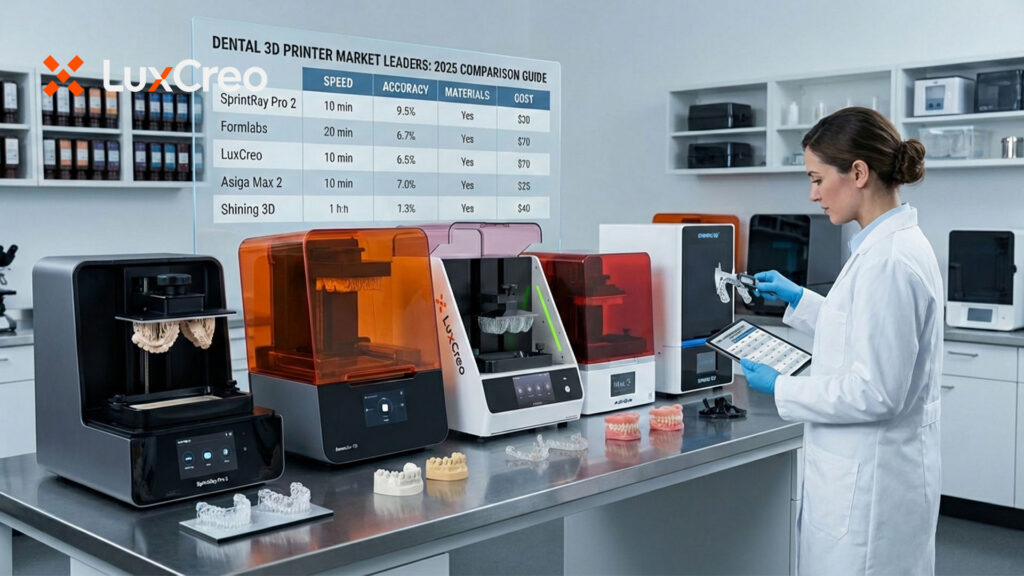
| Feature | LuxCreo iLux Pro Dental 3D Printer | SprintRay Pro 2 | Formlabs Form 4B | Asiga Max 2 |
| Print Technology | DLP (LEAP™) | DLP (Optical Panel) | SLA (MSLA) | DLP (SPS) |
| Build Volume | 192×108×200mm | 18.8×10.5×20cm | 20×12.5×21cm | 119×67×75mm |
| Resolution | 3840×2160 ppi, 50µm | 2K, 35µm | 50µm XY | Industry-leading |
| Direct Aligner Printing | ✅ FDA-Cleared | ❌ Models only | ❌ Models only | ❌ |
| Print Speed (Models) | Material-dependent | 30-40 minutes | 60-90 minutes | Moderate |
| Batch Capacity | 80 aligners | 6 models | 11 models | Multi-app |
| Dimensional Accuracy | 99% | High | 98.7% verified | Excellent |
| Print Success Rate | 99% | Not disclosed | 98.70% | High |
| Material Support | 23+ (open) | Limited (closed) | Strictly closed | 500+ (super-open) |
| Shape-Memory Material | ✅ ActiveMemory™ | ❌ | ❌ | ❌ |
| Variable Thickness AI | ✅ LuxDesign | ❌ | ❌ | ❌ |
| Digital Polishing | ✅ 80% clarity | ❌ | ❌ | ✅ Ultra Gloss |
| 1-Click Automation | ✅ Yes | Partial | Auto dispensing | Manual |
| Complete Package Price | ~$25,000-27,000 | ~$18,000 | $7,899-9,227 | $10,000-15,000 |
| Cost Per Aligner | $12.47 | ~$15.87 | ~$15.87 | N/A |
| Same-Day Delivery | ✅ 2-3 hours | ❌ (weeks) | ❌ (weeks) | ❌ |
| FDA Clearance | ✅ Class II | ✅ Models only | ✅ Models/restorations | ✅ Models |
| Best Application | Direct aligners | Model printing | Restoration printing | Lab multi-app |
| Support Response | 99% within 60min | Standard | Business hours | Standard |
ROI Analysis & Economics
Investment Requirements
LuxCreo iLux Pro Complete System:
- Printer: $12,000-15,000
- Software (LuxDesign + LuxFlow): Included
- iLuxWash Dental: $2,500-3,000
- iLuxCure Pro: $2,500-3,000
- Initial resin inventory: $2,000-3,000
- Total: $25,000-27,000
SprintRay Pro 2 Complete System:
- Printer: $8,500-9,500
- ProWash 2: $2,500-3,000
- ProCure 2: $2,500-3,000
- Service plan (annual): $1,500-2,000
- Initial resin inventory: $1,500-2,000
- Total: ~$18,000
Formlabs Form 4B Complete System:
- Printer: $3,999-5,999
- Wash 4 + Cure 4 bundle: $2,000-3,000
- 1-year service plan: $1,000-1,500
- Initial resin inventory: $800-1,000
- Total: $7,899-9,227
Per-Unit Cost Analysis
Direct-Print Aligner (LuxCreo):
- Labor: $2.72/aligner (1.5 minutes @ $108/hr lab rate)
- Material (resin): $4.67/aligner
- Software allocation: $5.00/aligner
- Equipment depreciation: Amortized
- Failure loss (1% failure rate): $0.08/aligner
- Total: $12.47/aligner
Thermoformed Aligner (SprintRay + External Thermoforming):
- Labor (printing + thermoforming): $3.90/aligner
- Material (plastic + model resin): $6.92/aligner
- Software allocation: $5.00/aligner
- Equipment depreciation: Amortized
- Failure loss: $0.05/aligner
- Total: $15.87/aligner
Cost Advantage: $3.40/aligner (19% savings)
Annual Economics (100 cases/month = 1,200 aligners/year)
Direct-Print Scenario:
- Annual material + labor: 1,200 × $12.47 = $14,964
- Equipment depreciation (5-year): $5,400
- Software/support: $1,200
- Total annual cost: $21,564
Thermoforming Scenario:
- Annual material + labor: 1,200 × $15.87 = $19,044
- Equipment depreciation: $3,600
- Thermoforming equipment depreciation: $1,000
- Software/support: $1,200
- Total annual cost: $24,844
Annual Savings: $3,280 (13.2% cost reduction)
Additional ROI Accelerators
Revenue Enhancement Factors:
- Same-day delivery improving case acceptance by 15-25%
- Reduced wait time frustration decreasing treatment cancellations
- Premium positioning enabling higher case fees
- Faster treatment cycles enabling more cases annually
- Diversified applications (retainers, splints, guides) amortizing equipment costs
Practice Case Study: Dr. Bill Layman
- Investment: ~$50,000 (two iLux Pro systems)
- Production increase: 300% weekly aligner volume
- Cost savings: $40,000+ annually in lab outsourcing
- ROI timeline: 4-6 months payback
- Current status: Operating two LuxCreo systems profitably
Clinical Evidence & Practitioner Testimonials
Documented Case Studies
Dr. Bill Layman – Orthodontic Practice “With the benefit of hindsight, I wish I would have researched LuxCreo before purchasing SprintRay. I now own two LuxCreo machines.”
Key metrics:
- Reduced lab outsourcing by 95%
- Same-day patient treatment initiation
- 3x weekly production capacity increase
- ROI achieved within months
Dr. Mike Pham – CEO of Affordable Dental “LuxDesign software saves my practice 60-75% in labor costs compared to traditional thermoformed workflows, and significantly shortens patient wait times.”
Key benefits:
- Reduced staffing dependency
- Faster case turnaround
- Improved patient satisfaction
- Competitive market differentiation
Dr. Neil Warshawsky – Orthodontist “Variable thickness aligners are the future of orthodontic aligner therapy—it’s the ‘holy grail,’ and LuxCreo invented it. 4D Aligner provides superior fit accuracy unmatched by thermoforming, better torque control, and requires fewer tooth attachments.”
Clinical advantages:
- Reduced attachment requirements
- Improved torque control
- Superior fit accuracy
- Shorter overall treatment duration
Prime Dental Laboratory (Denture Fabrication) “3D printed dentures deliver unrivalled aesthetics and functional results in half the production time… We’ve found exceptional durability with the ability to withstand extreme stress tests.”
Performance metrics:
- 12 hours (traditional) → 6 hours (3D printing) → 5 hours (with J5 DentaJet)
- Full-color monolithic dentures with multiple tooth shades
- Superior esthetic outcomes
- 350% year-over-year adoption growth
Market Trends Shaping Brand Leadership
Emerging Technology Adoption
Direct-Print Clear Aligners Market Explosion:
The 3D printed clear aligners market is projected to grow from $163.5 billion in 2025 to $366.2 billion by 2035, representing 12.74% CAGR. This explosive growth reflects fundamental market acceptance of direct-print technology and FDA clearance establishing regulatory pathways.
SLA vs. DLP Technology Debate:
- SLA maintains 52.6% market share for printing technology (as of 2025), valued for precision and surface quality
- DLP captures 37.8% market share, gaining momentum through speed advantages and direct-print aligner capability
- LCD technology emerging with cost advantages, though slower than DLP equivalents
Multicolor & Monolithic Production:
Stratasys’ J5 DentaJet multi-material jetting technology enabling single-build monolithic dentures with multiple tooth and base shades simultaneously represents emerging esthetic standard, driving 350% year-over-year adoption increases.
Regional Market Dynamics
North America Dominance:
- 39.6% global market share ($62.8 million in 2024)
- Advanced dental infrastructure supporting adoption
- High patient demand for cosmetic orthodontics
- Favorable reimbursement policies
- Concentrated investment in digital dentistry
Asia-Pacific Emerging Growth:
- Fastest CAGR during forecast period
- Increasing adoption in China and Southeast Asia
- Lower labor costs making digital solutions economically attractive
- Rising cosmetic dentistry demand among growing middle class
How to Select the Right Dental 3D Printer Brand
Evaluation Framework
- Define Your Clinical Priority
- Orthodontic focus: LuxCreo iLux Pro (direct-print)
- Restorative emphasis: Formlabs Form 4B or SprintRay Pro 2
- Denture production: Stratasys J5 DentaJet
- Laboratory flexibility: Asiga Max 2
- Assess Production Volume Requirements
- Low volume (<5 cases/week): Form 4B or SprintRay Pro 2
- Medium volume (5-20 cases/week): LuxCreo iLux Pro
- High volume (50+ cases/week): LuxCreo Lux 3D+ or Stratasys systems
- Evaluate Workflow Integration
- Same-day delivery requirement: LuxCreo direct-print only
- Traditional thermoforming acceptable: SprintRay or Formlabs
- Multi-application flexibility needed: Asiga Max 2
- Consider Material Ecosystem
- Maximum flexibility: Asiga (500+ materials)
- Balanced choice: LuxCreo (23+ materials)
- Proprietary optimization: Formlabs or SprintRay
- Assess Support Infrastructure
- Premium support priority: LuxCreo (99% within 60 minutes)
- Established protocols: SprintRay or Formlabs
- Global presence: Stratasys or 3D Systems
- Calculate Total Cost of Ownership
- Budget-conscious practices: Formlabs Form 4B (~$9,000)
- Value + performance: LuxCreo (~$27,000, but 19% cost/unit savings)
- Enterprise solutions: Stratasys or 3D Systems
Conclusion: Market Leadership and Your Practice
The dental 3D printer market offers unprecedented choice across diverse technologies and price points. Market leaders—Stratasys, 3D Systems, LuxCreo, SprintRay, Formlabs, and Asiga—each provide compelling solutions optimized for different clinical scenarios and business models.
However, market leadership does not necessarily align with optimal performance for your specific needs. Established players prioritize high-volume laboratory applications and diversified multi-material production. Emerging leaders like LuxCreo specifically engineer solutions for chairside orthodontic practices seeking disruptive same-day delivery capabilities.
Strategic Recommendation Framework
For Orthodontic Practices Seeking Competitive Advantage:
LuxCreo iLux Pro Dental 3D Printer stands alone with FDA-cleared direct-print aligner capability, enabling same-day treatment delivery, 19% cost-per-unit savings, 75% labor reduction, and typical 3-6 month ROI. The integrated hardware-software-material ecosystem minimizes operational complexity while delivering clinical outcomes superior to traditional thermoforming approaches.
For Established Practices Comfortable with Thermoforming Workflows:
SprintRay Pro 2 and Formlabs Form 4B deliver proven reliability, excellent model printing, and established user communities. Equipment costs are lower, but per-unit aligner costs remain 19% higher than direct-print alternatives, and patient wait times extend 2-4 weeks.
For High-Volume Dental Laboratories Requiring Material Flexibility:
Asiga Max 2 provides unmatched access to 500+ validated materials, supporting diverse applications (dentures, crowns, surgical guides, specialized restorations) with exceptional reliability proven across thousands of global installations.
For Enterprise-Scale Denture Production:
Stratasys J5 DentaJet multi-material jetting technology delivers monolithic full-color dentures with esthetic outcomes approaching traditional craftsmanship while reducing production time by 50%+, supporting 350% year-over-year adoption growth among high-volume labs.
Final Thoughts
The dental 3D printing landscape has fundamentally transformed. What was experimental five years ago—direct printing of orthodontic aligners—is now FDA-cleared and generating measurable ROI for thousands of practices. The question is no longer whether to adopt 3D printing, but which technology and vendor best align with your clinical vision and business objectives.
By systematically evaluating market leaders across technology, workflow integration, material flexibility, support quality, and total cost of ownership, you position yourself to make informed purchasing decisions that drive patient satisfaction, operational efficiency, and competitive differentiation.
The best dental 3D printer isn’t necessarily the market leader by sales volume. It’s the printer that transforms your practice toward your clinical goals while delivering sustained profitability and patient satisfaction.
Schedule Your System Demonstration
To experience direct-print aligner technology, model printing excellence, or enterprise-scale denture production firsthand, schedule demonstrations with leading providers:
LuxCreo Direct-Print Solutions:
- Website: https://luxcreo.com/
- Phone: +1 (650) 336-0888
- Services: Direct-print aligners, same-day delivery workflows, integrated post-processing
SprintRay Established Chairside Solutions:
- Model printing excellence, comprehensive ecosystem
Formlabs User-Friendly Precision:
- Restorative dentistry focus, intuitive operation
Asiga Laboratory Flexibility:
- Multi-application support, material ecosystem
This comprehensive comparison reflects current market analysis as of January 2026 Technologies, specifications, and market positions are subject to change. Always verify current information directly with manufacturers before making purchasing decisions. All cost figures, ROI timelines, and performance metrics are based on publicly available information and documented case studies.
Subscribe to Our Newsletter
Be the first to get our latest updates and free trials!
Popular Resources



Follow Us


Featured Products
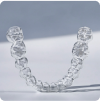
4D Aligner™
First Smart ActiveMemory™
Aligner
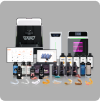
iLux Pro Dental Solution
Ultimate 1-Click Dental
Application Solution
LuxCloud Dental
Your One-stop Digital Dentistry
Platform