





Dental 3D Printer Comparison: Understanding DLP, SLA, and MSLA Technologies
Introduction
Selecting the right dental 3D printer requires understanding the underlying printing technologies that drive performance, accuracy, and workflow efficiency. The dental 3D printing market offers three primary technology platforms—Digital Light Processing (DLP), Stereolithography (SLA), and Masked SLA/Liquid Free Deposition (MSLA/LFD)—each with distinct advantages and trade-offs. This comprehensive guide helps you navigate these technological differences and make informed decisions aligned with your clinical and operational needs.
What Is Dental 3D Printer Technology Comparison?
Dental 3D printer technology comparison evaluates how different printing methodologies cure light-sensitive resin materials to fabricate custom dental appliances, from clear aligners and retainers to surgical guides and dental models. The three primary technologies differ fundamentally in how they apply light, cure material, and manage layer-to-layer processing. Understanding these distinctions directly impacts print speed, dimensional accuracy, surface quality, material compatibility, and equipment costs.
DLP: Digital Light Processing—The High-Speed Production Standard
How DLP Technology Works
Digital Light Processing employs a Digital Micromirror Device (DMD)—essentially a semiconductor chip containing millions of individually tilted mirrors. Each mirror represents one pixel. During printing, UV light projects through these dynamically positioned mirrors, curing entire layers simultaneously. This parallel-processing approach distinguishes DLP fundamentally from sequential laser-based technologies.
The LuxCreo proprietary LEAP™ (Light Enabled Additive Production) platform represents an advanced DLP implementation optimized specifically for dental applications. LEAP technology incorporates low peel-force mechanics, reducing mechanical stress during layer separation—a critical advantage when printing delicate structures like aligners or thin retainers that might fracture under excessive force.
Key Advantages of DLP
Parallel Layer Curing: Since DLP projects entire layers simultaneously, print speed remains independent of geometry complexity. Printing a single aligner takes essentially the same time as printing a full arch—a significant operational advantage for high-volume production.
Batch Processing Efficiency: The iLux Pro Dental, a DLP system utilizing LEAP technology, achieves 192×108×200 mm build platforms capable of printing 80 clear aligners per batch. This scale-up dramatically improves cost-per-unit economics compared to sequential printing approaches.
Consistency Across Build Platforms: Unlike scan-based systems vulnerable to optical aberrations, DLP mirrors maintain uniform positioning throughout print runs, supporting exceptional consistency across thousands of layers and multiple production cycles.
Material Versatility: DLP systems demonstrate broad compatibility with specialized dental resins—DCA (Direct Clear Aligner), DMR III (Dental Model Resin), DSG (Dental Surgical Guide), and DNG (Dental Night Guard)—enabling multi-application production without hardware reconfiguration.
DLP Limitations
DLP systems require substantial upfront capital investment ($15,000–$17,000 for desktop systems). Build platform resolution, while excellent at 50 µm pixel pitch, may not match SLA precision for applications demanding extreme detail. Additionally, membrane management and material compatibility require validated protocols to ensure consistent results.
SLA: Stereolithography—Laser-Directed Precision
How SLA Technology Works
Stereolithography employs galvanometer-directed laser scanners that trace individual layer geometry with laser light. A movable mirror deflects the laser beam to cure specific points within the print bed, creating geometry through sequential point-by-point curing. This inherently serial approach provides exceptional geometric precision but sacrifices speed compared to parallel technologies.
SLA Advantages
Exceptional Geometric Precision: Laser-based positioning enables sub-50 µm accuracy, making SLA ideal for applications demanding extreme detail—such as intricate surgical guides or implant guides requiring micron-level accuracy.
Minimal Waste: SLA’s selective curing approach produces minimal uncured resin waste, supporting sustainable production and lower material costs per part.
High-Resolution Surface Finish: Laser scanning enables superior surface definition, particularly valuable for esthetic applications like dentures or visible restorations where surface smoothness directly impacts patient satisfaction.
SLA Limitations
Speed Constraints: Sequential laser tracing limits production speed. Complex parts requiring extensive area coverage require substantially longer print times compared to DLP batch processing. A full-arch model might require 45–90 minutes, whereas DLP systems complete equivalent geometry in 10–20 minutes.
Platform Size Constraints: Traditional SLA systems typically feature smaller build platforms (20×12.5×21 cm typical), limiting batch capacity. Single-unit production is common, whereas DLP systems enable 50–80 unit batches.
Equipment Complexity: Laser optics require regular maintenance and calibration. Galvanometer mirror alignment and laser tube degradation over time necessitate professional service—increasing total cost of ownership.
MSLA/LFD: Masked SLA—Balancing Speed and Precision
How MSLA/LFD Technology Works
Formlabs’ proprietary LFD™ (Liquid Free Deposition) technology represents a hybrid approach combining LED arrays with spatial light modulators to project entire layer masks simultaneously—essentially combining DLP’s parallel processing efficiency with SLA’s optical precision. LED arrays illuminate specific wavelengths (typically 385 nm for optimal material compatibility), while dynamic masks control which regions cure each layer.
MSLA/LFD Advantages
Speed-Accuracy Balance: MSLA systems deliver 100 mm/hour theoretical throughput while maintaining 95%+ surface accuracy within 50 µm across the full build platform. Formlabs Form 4B exemplifies this category, producing 11 dental models in approximately 9 minutes.
Real-Time Process Monitoring: Advanced MSLA systems incorporate real-time optical feedback monitoring light intensity and curing consistency across the entire build platform. Asiga’s SPS (Substrate Positioning System) technology automatically compensates for light variations throughout lengthy production runs, ensuring consistency across thousands of layers.
Lower Equipment Cost: MSLA systems typically cost $10,000–$15,000—less than specialized DLP systems but more than entry-level LCD printers. Material costs align with traditional SLA, offering economic efficiency without sacrificing core capabilities.
Excellent Surface Quality: Pixel-level control delivers superior surface finish compared to DLP, particularly valuable for esthetic restorations and clear aligners where transparency and surface clarity directly impact clinical acceptance.
MSLA/LFD Limitations
Platform Size Constraints: Build platforms typically measure 20×12.5×21 cm, supporting single-model production or partial batches. Batch capacity substantially lags behind DLP systems, limiting scale-up efficiency.
Material Dependency: MSLA performance depends critically on material formulation optimized for specific LED wavelengths. Cross-platform material compatibility is limited compared to wavelength-agnostic technologies.
Direct-Printed Aligners: The DLP Advantage
The FDA-cleared LuxCreo direct 3D-printed clear aligner system demonstrates why DLP technology dominates next-generation aligner manufacturing. Direct printing eliminates thermoforming steps entirely, enabling same-day aligner delivery (scan-to-finished aligner in 2–3 hours).
LuxCreo’s DCA (Direct Clear Aligner) resin achieves 99% dimensional accuracy within ±0.1 mm tolerances—compared to ±0.2 mm for thermoformed alternatives. This precision improvement reflects DLP’s superior layer-by-layer consistency. The LEAP™ low peel-force architecture prevents stress on delicate aligner geometry that would fracture under SLA or MSLA mechanical forces.
Direct-printed aligners using ActiveMemory™ shape-memory polymers deliver thermoreversible recovery properties unavailable with conventional thermoformed materials. Immersion in 60°C hot water restores original aligner geometry, effectively delivering “fresh aligner” mechanical properties daily—a clinical advantage reflected in superior force delivery and patient comfort.
Technology Specifications Comparison Table
| Specification | DLP (LEAP) | SLA | MSLA/LFD |
| Build Volume (Example) | 192×108×200 mm | 20×12.5×21 cm | 20×12.5×21 cm |
| Batch Capacity | 80 aligners | 1–2 models | 6–11 models |
| Print Speed | 9–40 min/aligner | 45–90 min/model | 15–30 min/model |
| XY Resolution | 50 µm pixel | 30–50 µm | 50–75 µm |
| Z-Axis Resolution | 25–100 µm | 25–50 µm | 50–100 µm |
| Dimensional Accuracy | 99% within ±0.1 mm | 95%+ within ±0.05 mm | 95%+ within ±0.1 mm |
| Surface Finish | Excellent with Digital Polishing | Superior detail | Excellent smoothness |
| Material Compatibility | Broad (DCA, DMR, DSG, DNG) | Wide range | Limited to specific wavelengths |
| Capital Equipment Cost | $15K–$17K | $8K–$12K | $10K–$15K |
| Workflow Ideal For | High-volume direct-print aligners | Precision surgical guides | Balanced production |
Process Mechanics: Real-Time Feedback and Consistency
Premium dental 3D systems distinguish themselves through sophisticated process mechanics ensuring consistency across lengthy production runs. Asiga systems incorporate real-time LED power adjustment and substrate positioning feedback (SPS technology), automatically compensating for light variations throughout production. This feedback mechanism is unavailable on commodity alternatives, explaining performance differences across ostensibly similar systems.
LuxCreo’s LEAP platform similarly incorporates proprietary optical monitoring, ensuring that layer 1 and layer 1000 maintain identical cure depth and mechanical properties—a critical requirement for reproducible biocompatible appliances.
Equipment Longevity and Maintenance Implications
DLP Systems: DMD chips demonstrate exceptional longevity (>30,000 operating hours typical). Membrane replacement represents primary maintenance. Service requirements are minimal compared to laser-based alternatives.
SLA Systems: Laser tubes degrade over time (typically 5,000–10,000 operating hours). Galvanometer mirror alignment requires periodic recalibration. Service costs accumulate significantly over equipment lifetime.
MSLA/LFD Systems: LED arrays demonstrate superior longevity compared to lasers. Optical element cleaning represents primary maintenance. Overall service costs typically lower than SLA systems.
Application-Specific Technology Selection
Direct 3D-Printed Aligners: DLP (LEAP) exclusively, due to batch processing capability and ActiveMemory polymer compatibility.
Dental Models (High Volume): DLP systems for throughput; MSLA for cost-conscious labs; SLA for precision-critical applications.
Surgical Guides: SLA preferred for precision; MSLA acceptable with validated protocols; DLP suitable for production-volume guides.
Dentures and Esthetic Restorations: MSLA for superior surface finish; SLA for exceptional detail; DLP for high-volume production.
Workflow Integration and Automation
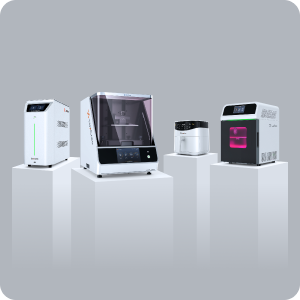
Modern dental 3D systems integrate design software, printing hardware, post-processing equipment, and cloud connectivity into complete ecosystems. LuxCreo’s integrated approach—combining iLux Pro Dental (3D printer), LuxDesign (AI-powered design software), LuxFlow (workflow management), iLuxWash (automated washing), and iLuxCure Pro (automated curing)—exemplifies end-to-end system optimization. This integration ensures validated protocols, consistent results, and regulatory compliance—critical for medical device manufacturing.
Stand-alone printer selections without integrated post-processing and software often sacrifice consistency and increase labor requirements, negating technology advantages.
Cost-Per-Part Analysis: Technology Economics
DLP (Direct-Print Aligners): $12.47 per aligner (equipment + material + software amortized across production volume). Batch production dramatically reduces per-unit costs.
Thermoformed Aligners (Traditional Workflow): $15.87 per aligner. Model production, thermoforming equipment, and manual finishing increase total costs.
Lab Models (MSLA): $8–$12 per model with efficient batching; $12–$18 per model with SLA due to slower throughput.
Volume drives technology economics. High-volume operations (20+ aligners weekly) strongly favor DLP batch processing. Lower-volume operations may benefit from MSLA cost-per-unit advantages.
Regulatory Considerations
FDA Class II 510(k) clearance represents the most stringent validation. LuxCreo’s FDA Class II clearance for direct 3D-printed clear aligners mandates using validated hardware (iLux Pro Dental), materials (DCA resin), software (LuxDesign, LuxFlow), and post-processing protocols (iLuxWash, iLuxCure Pro). Mixing validated and non-validated components risks losing regulatory compliance and clinical efficacy guarantees.
SLA and MSLA systems may support multiple vendor ecosystems, introducing complexity but potentially enabling flexibility. Careful vendor selection ensures biocompatibility validation and regulatory alignment.
Future Technology Trends
Emerging innovations include wavelength optimization enabling broader material compatibility, artificial intelligence-enhanced design automation reducing labor requirements, and multi-material printing enabling single-batch mixed applications (e.g., printed aligners, retainers, and night guards simultaneously).
LuxCreo’s next-generation LEAP platforms promise continued speed-to-market acceleration while maintaining precision and material compatibility. Formlabs continues refining LFD technology toward increased platform size and batch capacity. Asiga remains focused on precision printing for surgical and implant applications.
Conclusion
Dental 3D printer technology comparison requires evaluating parallel-processing DLP systems against sequential SLA approaches and hybrid MSLA/LFD alternatives. DLP delivers unmatched batch processing efficiency, enabling same-day direct 3D-printed aligners—a transformational capability unavailable through alternative technologies. SLA excels in precision-critical applications where geometric detail matters most. MSLA/LFD balances speed and precision, offering economical mid-market solutions.
Successful technology selection depends on aligning organizational priorities—high-volume production favors DLP; precision requirements drive SLA selection; balanced operations benefit from MSLA pragmatism. Integrated end-to-end ecosystems ensure validated protocols, regulatory compliance, and consistent clinical results.
The next generation of digital dentistry belongs to practices selecting technologies and workflows optimized for their specific clinical and operational requirements. DLP’s direct 3D-printed aligner capability, validated through FDA clearance and supported by AI-powered design automation, represents the current state-of-the-art for orthodontic transformation.
Subscribe to Our Newsletter
Be the first to get our latest updates and free trials!
Popular Resources




Follow Us


Featured Products
4D Aligner™
First Smart ActiveMemory™
Aligner
iLux Pro Dental Solution
Ultimate 1-Click Dental
Application Solution

LuxCloud Dental
Your One-stop Digital Dentistry
Platform