





Direct-Print Aligners: Balancing Benefits and Drawbacks
Orthodontic treatment is undergoing a paradigm shift with the emergence of direct-print clear aligners. By combining digital workflows and advanced polymers, direct printing promises unprecedented precision, efficiency, and sustainability. Yet, as with any innovation, it presents unique challenges. This article explores the science, workflows, clinical impacts, and future directions of direct-print aligners—offering clinicians and labs a comprehensive guide to weighing the pros and cons.
Introduction
Clear aligners have revolutionized orthodontics by providing removable, aesthetic, and patient-friendly alternatives to braces. Thermoformed aligners—introduced in 1998—rely on vacuum-forming plastic sheets over dental models. This results in various drawbacks, including irreversible material creep, uneven thickness, and rapid force decay, which prevent efficient and predictable tooth movement. In contrast, direct-print aligners fabricate the appliance itself from biocompatible resin in a single step, layer by layer. This direct process eliminates model errors and streamlines production, setting the stage for next-generation aligner therapy. Direct printing enables more precise and convenient appliances, resulting in happier patients and more predictable treatments.
How Direct-Print Aligners Work
The digital workflow begins with intraoral scanning (IOS) to capture dentition, followed by treatment planning software that simulates tooth movements in sequential stages. Instead of printing each stage’s model, direct printing uses a clear, photocurable resin—such as LuxCreo’s DCA resin with ActiveMemory™ polymer—to build the aligner layer by layer. Post-print, aligners undergo cleaning, heat, and UV curing, and finishing steps before patient delivery.
Advantages of Direct-Print Aligners
Precision and Fit
Direct printing ensures dimensional accuracy by eliminating thermoforming distortions and model-related errors. Studies report overall fit improvements from approximately 75% with thermoforming to over 96% accuracy with direct printing, reducing discrepancies to under 0.2 mm.
Enhanced Material Properties
LuxCreo’s ActiveMemory™ polymer maintains consistent modulus at intraoral temperatures and restores both geometry and force after hot-water treatment at 60 °C. This dual-mechanism design delivers predictable forces throughout wear and enables rejuvenation abilities, overcoming the irreversible deformation common to thermoformed plastics and ensuring more predictable treatment outcomes. Additionally, the hot water soak, especially with a Polydent tablet, enhances aligner hygiene.
Reduced Manufacturing Time and Cost
By removing model fabrication and outsourcing, direct printing cuts production workflows from days to hours. Chairside setups can deliver aligners within 2–3 hours of scanning, slashing labor costs by up to 75% compared to outsourced thermoforming.
Customizable Staging and Geometry
Digital control through programs like LuxDesign allow programmable thickness gradients and precise trim lines. Clinicians can tailor local thickness for force modulation—thickening areas requiring reinforcement and thinning occlusal surfaces to enhance comfort—all reproducible across batches.
Sustainability
Direct printing minimizes waste: nearly all resin forms part of the aligner, unlike thermoforming sheets that yield off-cuts.
Drawbacks and Limitations
Initial Investment
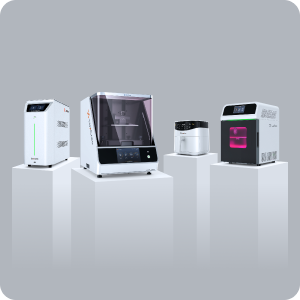
Clinics must purchase 3D printers, validated resins, wash and cure stations, and design software. Though space-efficient, the capital outlay can be significant for smaller practices.
Regulatory and Material Approval
Direct-print aligners are FDA Class II devices requiring 510(k) clearance. Material formulations must pass extensive biocompatibility tests. Limited resin options can constrain material choice until new polymers gain approval.
Learning Curve
Technicians need training in printer calibration, appliance design, resin handling, and printing and post-processing protocols. Deviations in validated workflows risk compromised mechanical properties or biocompatibility.
Quality Control
Variability in printer hardware, resin batches, and post-cure parameters necessitates strict validation. Frequent mechanical testing and clinical auditing ensure consistent force delivery and fit.
Comparison with Thermoformed Aligners
| Aspect | Thermoformed Aligners | Direct-Print Aligners |
| Workflow | Scan → 3D print model → thermoform sheet | Scan → direct-print aligner |
| Production Time | Days (outsourced) | Hours (chairside) |
| Fit Accuracy | ~75% overall | >96% overall |
| Material Homogeneity | Thickness variation up to 50% | Uniform or gradient-controlled |
| Equipment Footprint | Larger (model lab + thermoformer) | Compact (printer + post-processing) |
| Waste Generation | Resin models + sheet off-cuts | Minimal resin waste |
| Initial Force Predictability | Degrades due to creep and water absorption | Consistent elastic force; restoration via heat |
Clinical and Practice Considerations
Integrating direct-print aligners into practices enhances same-day treatment starts and reduces chairside visits. Comprehensive staff training and validated end-to-end solutions are essential for safety and reliability. Clear patient communication about aligner care—especially thermal restoration steps—facilitates smoother adoption.
Conclusion
Direct-print aligners represent a transformative leap in orthodontic appliance manufacturing—offering superior precision, efficiency, and sustainability. However, practitioners must balance initial investments, regulatory compliance, and workflow adaptation against these benefits. As materials like ActiveMemory™ polymer continue to mature and long-term data emerge, direct printing is poised to become the new gold standard in clear aligner therapy.
Subscribe to Our Newsletter
Be the first to get our latest updates and free trials!
Popular Resources





Follow Us


Featured Products
4D Aligner™
First Smart ActiveMemory™
Aligner
iLux Pro Dental Solution
Ultimate 1-Click Dental
Application Solution

LuxCloud Dental
Your One-stop Digital Dentistry
Platform