






Dental 3D Printer Industry Analysis: Market Trends, Competitive Landscape, and Technology Roadmap
Market Growth and Valuation
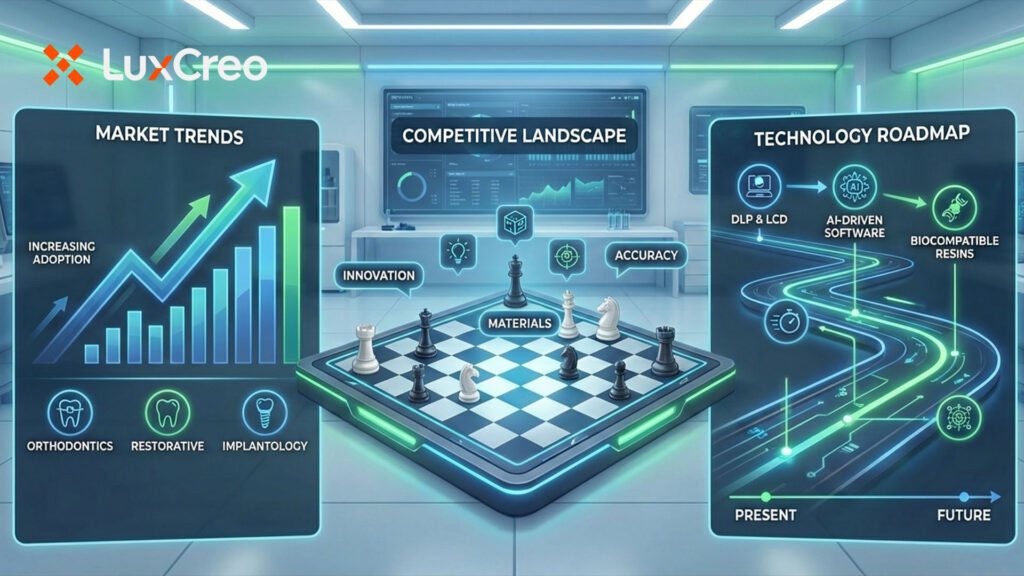
The dental 3D printing market stands at a critical inflection point. Global market valuations vary across sources, reflecting the rapidly evolving nature of the sector. According to MarketsandMarkets, the market reached USD 3.96 billion in 2025 and is projected to reach USD 10.06 billion by 2030, representing a CAGR of 20.5%. However, a more conservative forecast from Grand View Research estimates the market at USD 3.9 billion in 2024, growing to USD 15.9 billion by 2030 at a CAGR of 26.4%. This variance underscores significant market uncertainty and the potential for higher growth trajectories as the technology matures.
Within the United States specifically, the dynamics are even more pronounced. The U.S. market was valued at USD 1.2 billion in 2024 and is expected to reach USD 4.96 billion by 2030 at a CAGR of 26.2%, indicating accelerating adoption in the world’s largest dental market. These growth rates substantially exceed broader additive manufacturing sectors, demonstrating dental 3D printing as one of the highest-growth niches within the AM industry.
Segmentation and End-Use Dominance
Dental laboratories currently dominate the market, accounting for 55.6% of global market share in 2023, and are expected to maintain the highest CAGR at 26.7% through 2030. This laboratory dominance reflects the economics of scale—large dental labs can justify investment in high-volume production systems and achieve rapid return on investment through outsourcing relationships with dental practices.
Within applications, the orthodontics segment leads the market, driven by the explosive growth of clear aligner therapy. The global clear aligner market alone is projected to reach USD 29.9 billion by 2030, with 3D printing technology becoming increasingly integral to production. Other significant applications include surgical guides, dental models, prosthetics, night guards, and retainers—each benefiting from direct printing capabilities that eliminate traditional intermediate steps like thermoforming and manual finishing.
Regional Expansion and Emerging Markets
North America maintains the largest regional market share at 37-39.6% in 2024, driven by advanced healthcare infrastructure, high disposable income for cosmetic dentistry, and rapid technology adoption rates. Approximately 15% of U.S. dental practices had implemented at least one 3D printer by the end of 2024, representing a significant penetration milestone.
However, Asia Pacific emerges as the fastest-growing region, with projected growth at 27.1% CAGR through 2030. This acceleration is fueled by expanding middle-class populations in India, Vietnam, and China; government initiatives promoting oral health; increasing dental tourism; and rising per capita incomes. China and India are positioned to spearhead regional growth, with manufacturers investing heavily in localized manufacturing and distribution infrastructure.
Europe represents the second-largest market, driven by strong digital dentistry adoption, extensive networks of dental clinics and laboratories, and regulatory frameworks that facilitate innovation while maintaining safety standards.
Competitive Landscape: Market Leaders and Disruption
The dental 3D printing market exhibits a dual-tier competitive structure. Established printer manufacturers include Stratasys ($498 million in dental revenues), 3D Systems ($640 million), EnvisionTEC, Formlabs, and Asiga. These companies leverage existing additive manufacturing expertise and established distribution channels.
Emerging competitors have carved distinctive niches through technological innovation:
LuxCreo achieved a watershed moment in 2022 by obtaining FDA Class II 510(k) clearance for direct-print aligners—the world’s first such approval. This breakthrough fundamentally altered competitive dynamics by enabling in-office production of finished aligners without thermoforming, reducing production time from weeks to 2-3 hours. The company subsequently achieved strategic partnership with Angelalign Technology (October 2025), receiving significant investment to co-develop next-generation 3D printing materials for clear aligners, signaling the convergence of aligner specialists and 3D printing technology providers.
SprintRay and Formlabs maintain strong positions through cloud-integrated design platforms and user-friendly ecosystems, though both remain limited to dental model printing with subsequent thermoforming for aligner production. Stratasys continues expanding through strategic partnerships—announcing collaborations with Spanish, German, and other European dental service providers in 2025 to distribute its dental 3D printing solutions.
This competitive structure reveals an ongoing shift: the most disruptive value creation occurs not in printer hardware alone, but in integrated ecosystems combining hardware + software + biocompatible materials to minimize post-processing and maximize clinical efficiency.
Competitive Advantage Metrics
| Factor | Direct-Print Leaders (LuxCreo) | Model + Thermoform (SprintRay, Formlabs) | Traditional Methods |
| Production Time | 2-3 hours (scan to delivery) | 8-12+ hours per batch | Weeks (outsourced) |
| Cost Per Aligner | ~USD 12.47 | ~USD 15.87 | Higher labor-dependent |
| Material Waste | Minimal | Moderate | Up to 80% waste reduction vs. thermoforming |
| Aligner Thickness Uniformity | 0.5 mm (customizable) | 0.38-0.69 mm (variable) | Inconsistent |
| FDA Clearance for Patient Contact | Yes (Class II 510(k)) | Model-only (no direct patient contact) | N/A |
| Capital Requirements | Desktop and lab-grade systems available | Desktop-focused | High (traditional equipment) |
The direct-print advantage is not marginal—practices report 3x revenue growth with identical staffing, 40% production capacity increases, and 19% cost reductions per aligner when implementing direct-print systems.
Technology Roadmap: Emerging Innovations
AI-Driven Automation and Predictive Manufacturing
Next-generation systems are integrating AI-powered design optimization and machine learning-enabled parameter tuning. LuxCreo’s upcoming Dental Automation Platform (DAP) will feature automated post-processing, predictive maintenance systems, and real-time process monitoring. These systems analyze historical production data to automatically optimize print parameters for specific resin-geometry combinations, reducing operator dependency and improving consistency.
Multi-Material and Gradient Printing
Emerging research explores gradient-stiffness aligners and integrated attachment printing in single manufacturing operations. Rather than bonding attachments post-printing, future systems may print varying resin elasticity across different regions—softer materials for patient comfort, stiffer zones for precise force control. This capability would require advancing photopolymer chemistry to enable multi-material curing within single print cycles.
Bioprinting and Tissue Regeneration
3D bioprinting represents a paradigm shift beyond prosthetic devices toward living tissue regeneration. Research has demonstrated viability for:
- Periodontal tissue regeneration: 3D bioprinting scaffolds incorporating stem cells, extracellular matrix materials, and growth factors to regenerate periodontal ligament, alveolar bone, and gingival tissue simultaneously
- Dental pulp and dentin regeneration: Advanced bioinks enabling vascularized tissue constructs for pulp-dentin regeneration
- Whole tooth bioprinting: Long-term vision of fabricating functional teeth with complete dentin-pulp-periodontal systems
While still in research phases, bioprinting technology validation in clinical trials suggests commercialization of tooth regeneration products within 5-10 years—representing a multi-billion-dollar expansion of the addressable market.
Smart Materials and Shape Memory Polymers
ActiveMemory™ polymers represent a significant materials innovation, providing continuous gentle force application with shape memory properties. These materials enable more predictable tooth movement, reduce reliance on mechanical attachments, and improve patient comfort. The Angelalign-LuxCreo partnership specifically targets next-generation ActiveMemory formulations with enhanced biocompatibility and force delivery characteristics.
Cloud Integration and Smart Factory Models
The industry is moving toward distributed manufacturing networks. Cloud-based design platforms enable practitioners to design cases, which are then automatically routed to the nearest available production facility (whether in-house, regional lab, or smart factory). Real-time inventory management, demand forecasting, and dynamic pricing optimization become possible when manufacturing is virtualized and connected.
Regulatory Landscape and Compliance Framework
FDA Classification and Pathways
The regulatory environment reflects the dual nature of dental 3D printing devices: printers are not regulated as they are not finished medical devices, but materials used to fabricate dental products are treated as finished devices under FDA oversight. This creates unique regulatory requirements:
510(k) Premarket Notification is the primary pathway for most dental 3D-printed products. Manufacturers must demonstrate substantial equivalence to legally marketed predicate devices in terms of:
- Intended use and patient population
- Design and technological characteristics
- Performance testing results
- Manufacturing processes and quality systems
FDA Material Clearance is distinct from device approval. Dental resins receive individual FDA clearances as Class II medical devices specific to their intended applications. For example, LuxCreo’s Dental Clear Aligner (DCA) resin underwent rigorous biocompatibility testing per ISO 10993 standards and received FDA 510(k) clearance for direct patient contact—a critical advantage competitors lack.
Biocompatibility Standards and Material Testing
ISO 13485 quality management systems and ISO 10993 biocompatibility standards form the regulatory foundation. Materials must demonstrate:
- Cytotoxicity assessment: Cell culture studies confirming non-toxic residual monomer levels
- Sensitization and irritation testing: Evaluation of allergenic potential and tissue irritation
- Long-term stability testing: Verification that materials maintain properties under oral conditions
- Mechanical property validation: Confirmation of strength, elasticity, and durability appropriate for intended use
Post-processing procedures significantly impact biocompatibility. Studies demonstrate that ethanol washing can markedly decrease material toxicity, making standardized cleaning protocols essential compliance components.
International Regulatory Divergence
The European Medical Device Regulation (MDR) applies more stringent pre-market requirements than FDA’s 510(k) pathway, with CE Marking demanding comprehensive clinical evidence and post-market surveillance. This creates incentive for manufacturers to exceed FDA standards to simultaneously satisfy European requirements.
Asian markets (Japan PMDA, China NMPA) maintain distinct pathways, though most manufacturers report that achieving stringent MDR compliance facilitates subsequent approvals in other markets.
Regulatory Challenges for Emerging Applications
Bioprinting and living tissue constructs face unprecedented regulatory ambiguity. These products combine cells, growth factors, and biomaterials into constructs that function more like biological drugs than traditional medical devices. Regulatory frameworks are still evolving, with the FDA issuing guidance in 2024-2025 on how to classify and approve cell-containing dental constructs. This regulatory uncertainty is likely to delay commercialization of bioprinted tooth regeneration products until 2027-2030.
Key Market Drivers and Restraints
Drivers:
- Rising prevalence of dental caries and periodontal disease (30-40% of population in developed countries)
- Aging global population requiring prosthetics and restorations
- Increasing demand for cosmetic dentistry and aesthetic solutions
- Adoption of digital dentistry workflows reducing manual processes
- Regulatory pathway clarity (particularly FDA 510(k) approvals) reducing market entry risk
- Strategic partnerships and material supplier ecosystem expansion
Restraints:
- High initial capital investment (USD 50,000-200,000+ for production-grade systems)
- Shortage of technically trained dental professionals and lab technicians
- Material cost premiums relative to traditional manufacturing (though offset by reduced labor)
- Regulatory compliance complexity requiring in-house expertise or consultants
- Variation in international regulatory requirements increasing complexity for global expansion
- Resin supply chain limitations and material availability constraints
Future Market Evolution: 2026-2030 Outlook
By 2030, the industry is likely to consolidate around three distinct market tiers:
- High-Volume Smart Factories: Regional manufacturing hubs operating distributed 3D printing networks coordinated through cloud platforms. Stratasys, 3D Systems, and established lab networks are positioned to dominate this tier through capital-intensive infrastructure investment.
- Practice-Integrated Production: In-office 3D printing becoming standard in orthodontic and dental practices, driven by FDA clearance of direct-print systems and sub-USD 100,000 device pricing. LuxCreo and next-generation competitors will lead this segment.
- Research and Regenerative Applications: Bioprinting platforms for tissue regeneration, initially in specialized centers and research institutions, transitioning to clinical practice as regulatory pathways clarify.
The convergence of AI-driven automation, next-generation smart materials, regulatory clarity, and global market expansion positions dental 3D printing as one of the highest-growth additive manufacturing sectors through the 2030s, with compound growth rates potentially exceeding 25% annually in key geographies like Asia Pacific and North America.
Subscribe to Our Newsletter
Be the first to get our latest updates and free trials!
Popular Resources




Follow Us


Featured Products
4D Aligner™
First Smart ActiveMemory™
Aligner
iLux Pro Dental Solution
Ultimate 1-Click Dental
Application Solution

LuxCloud Dental
Your One-stop Digital Dentistry
Platform