





The Ultimate Guide to 3D Printers for Dental: Technology, Applications, Selection, and Top Brands
From direct-printed aligners to same-day surgical guides, dental 3D printers are reshaping how orthodontists, dentists, and lab technicians deliver patient care. This comprehensive guide explores the technology driving this transformation, the diverse applications revolutionizing dental workflows, practical selection criteria for choosing the right printer, and the leading brands dominating the market.
Understanding Dental 3D Printing Technology
Core Technologies: DLP, SLA, and LCD
Dental 3D printing relies on three primary technologies, each with distinct advantages and limitations:
Digital Light Processing (DLP) represents the gold standard for dental applications today. DLP printers use a digital projector with a Digital Micromirror Device (DMD) to flash an image of an entire layer onto liquid resin simultaneously. This approach offers exceptional speed—entire layers cure in seconds—and delivers outstanding precision with pixel sizes as small as 25-50 microns. DLP technology provides consistent batch-to-batch accuracy and requires minimal post-processing, making it ideal for high-volume production. The wavelength options (385nm or 405nm) allow practitioners to balance speed and precision based on specific needs. While DLP printers traditionally command higher price points, their superior reliability and production capabilities justify the investment for professional dental environments.
Stereolithography (SLA) uses a laser to precisely trace and cure resin layer by layer, achieving exceptional detail for intricate applications. SLA excels at producing small, complex parts with excellent surface finishes. However, laser-based scanning makes SLA significantly slower than DLP—especially when printing multiple parts—since each layer requires point-by-point tracing. The large resin reservoirs required for SLA printing demand substantial material investment.
Liquid Crystal Display (LCD) technology represents an emerging and increasingly popular option for dental 3D printing. LCD printers use liquid crystal panels to mask light and expose resin layers uniformly. This technology offers several compelling advantages: affordability compared to DLP systems, reduced light intensity requirements, and simplified operation. LCD printers deliver impressive detail and accuracy at entry-level price points, making them attractive for practices new to 3D printing. However, LCD printers typically operate more slowly than equivalent DLP systems, and their light source has a shorter lifespan (around 800 hours versus 10,000 hours for advanced DLP LEDs). For high-volume, demanding applications, DLP remains superior; for flexibility and budget considerations, LCD offers excellent value.
Key Printing Parameters
Understanding resolution and accuracy is fundamental to selecting the right printer:
XY Resolution refers to the horizontal pixel size projected onto the resin. Dental DLP printers typically feature pixel pitches of 50 microns, though advanced systems offer 25-micron resolution. Smaller pixels enable smoother surface finishes and better capture of fine anatomical details critical for dental applications.
Z-Axis Resolution (layer thickness) ranges from 25 to 150 microns, depending on the application. Thinner layers (25-50 µm) produce superior detail for crowns, bridges, and advanced surgical guides but extend print times. Standard dental applications use 50-100 µm layers as the optimal balance between detail and efficiency. Thicker layers (125-150 µm) suit rapid model production where fine layer lines are less critical.
Accuracy in 3D dental printing means reproducible, validated results across repeated builds. This encompasses dimensional precision, surface uniformity across the entire build platform, and consistent mechanical properties.
Major Dental 3D Printing Applications
Dental 3D printing has revolutionized production across numerous clinical applications:
Clear Aligners and Retainers
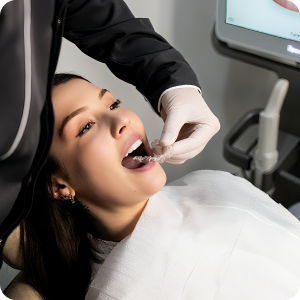
Direct 3D printing of clear aligners represents perhaps the most disruptive innovation in digital dentistry. Traditional workflows required printing dental models, thermoforming aligner material over these models, and then performing manual finishing. Modern direct-print technology eliminates these intermediary steps entirely. Practitioners scan patient dentition, automatically generate aligner designs, and print transparent aligners directly—reducing production time from weeks to just 2-3 hours. FDA-cleared direct-print aligner systems, such as LuxCreo, deliver 80% higher clarity than competing approaches while reducing polishing labor by 75%. For orthodontic practices, this capability means same-visit treatment initiation, dramatically improved patient satisfaction, and increased case acceptance rates.
Surgical Guides
3D printed surgical guides enable precise implant placement by creating patient-specific guides that position implants at predetermined angles and depths. Digital treatment planning software merges intraoral scans with CBCT imaging to establish optimal implant positioning. The CAD design then generates a surgical guide that stabilizes the drill trajectory, eliminating variables from freehand placement. These guides dramatically reduce operative time while improving final restoration accuracy and long-term implant success rates.
Dental Models
Digital workflows have transformed model production from plaster-based manual processes to rapid 3D printing. Intraoral scanners capture tooth geometry with micron-level precision, automatically generating printable models within minutes. Dental-specific software automatically orients models for optimal print orientation, generates intelligent support structures, and enables batch printing of multiple models simultaneously. This capability enables labs to produce complete cases overnight and allows practitioners to print models chairside for immediate patient communication and treatment planning.
Crowns and Bridges
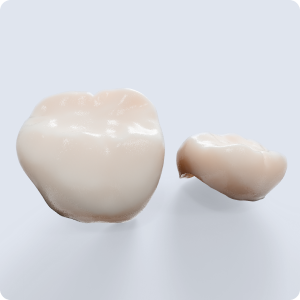
Digital design combined with 3D printing enables rapid fabrication of definitive crowns and bridges. Practitioners design restorations from intraoral scans, optimizing margins and occlusal surfaces within digital software. High-precision DLP printing captures margin geometry and contact points with exceptional accuracy. Advanced materials now offer sufficient strength and esthetics for definitive restorations, though many practitioners continue using 3D-printed crowns as provisional restorations pending lab-milled definitive options.
Splints and Night Guards
Occlusal splints and night guards benefit enormously from 3D printing’s capabilities. Digital design enables precise thickness variation—creating strategic reinforcement in stress-bearing areas while maintaining comfort elsewhere. Direct 3D printing eliminates the thermoforming process entirely, reducing production time to minutes and ensuring consistent, predictable outcomes. Flexible resin materials (like KeySplint Soft or LuxCreo DNG) provide the comfort and retention characteristics patients expect.
Dentures
Complete denture fabrication represents an emerging application where 3D printing offers significant advantages. Digital workflows enable precise capture of ridge anatomy and vertical dimension, while 3D printing produces accurately fitted denture bases. Some practitioners print denture bases directly, while others print models for traditional denture processing. Novel denture base resins now offer biocompatibility and esthetic properties approaching conventional dentures while dramatically reducing manufacturing time.
Impression Trays and Indirect Bonding Trays
Custom impression trays and indirect bonding trays produced via 3D printing fit individual patient anatomy precisely, ensuring complete impression capture while minimizing material waste. These applications leverage 3D printing’s speed and precision while significantly improving clinical outcomes compared to generic trays.
How to Choose the Right Dental 3D Printer
Selecting a dental 3D printer requires systematic evaluation across multiple criteria:
Define Your Clinical Needs
Begin by identifying the specific applications your practice requires. Orthodontic-focused practices pursuing same-day aligner delivery need different capabilities than general practices wanting chairside restoration options or labs requiring high-volume model production. Your intended application portfolio directly influences optimal printer specifications and material requirements.
Evaluate Print Speed and Workflow Integration
Print speed matters, but workflow integration matters more. Calculate the complete cycle time—from design preparation through post-processing—not just raw printing time. Consider whether the printer integrates with your existing digital systems (intraoral scanners, treatment planning tools). A printer slightly slower than alternatives may deliver superior overall efficiency if its software ecosystem eliminates manual steps and integrates seamlessly with your practice management system.
For same-day dentistry, evaluate actual production timelines for your specific applications. A printer printing models in 30 minutes adds no value if support removal, washing, curing, and finishing require an additional 45 minutes of manual labor.
Assess Accuracy and Print Quality
Request validated accuracy data specific to your intended applications—not just theoretical specifications. Some manufacturers provide clinical studies demonstrating that their printers consistently reproduce CAD design geometry within 50 microns across entire build platforms. Ask for sample prints or arrange demonstrations to print your specific applications.
Evaluate surface finish quality across different layer thickness settings. Superior printers deliver smooth surfaces with minimal post-processing requirements, while others produce visible layer lines requiring significant polishing. For transparent aligners or clear surgical guides, this difference proves critical for patient acceptance and clinical outcomes.
Consider Material Compatibility and Flexibility
Material selection dramatically impacts both clinical outcomes and operational costs. Closed systems using proprietary resins offer optimized performance but limit flexibility and potentially increase consumable costs. Open systems support validated third-party materials, offering choices that may better suit your applications while potentially reducing costs.
Evaluate whether the printer supports the specific materials you need. If your practice requires LuxCreo DNG for premium splint production or specialized resins for novel applications, ensure the printer offers validated compatibility. Many leading manufacturers now support 20+ dental-specific resins, providing flexibility across diverse applications.
Build Platform Size and Volume
Build platform dimensions directly affect production efficiency. Smaller platforms (around 120 x 68mm) suit chairside applications or small-volume production, fitting just 2-3 full arch models at a time. Larger platforms (150+ mm) enable batch printing of multiple patient cases simultaneously, critical for high-volume lab operations. Consider your typical production scenarios—practices printing 1-2 cases daily need different platform sizes than labs producing 50+ cases overnight.
Software and User Experience
Dental-specific software dramatically impacts printer utility. Superior systems offer one-click automation for support generation, orientation optimization, and slicing—transforming complex technical tasks into single-button operations. Cloud-based design services, integrated AI-powered design optimization, and seamless connectivity with treatment planning software distinguish premium systems from basic alternatives.
It’s not just the software, either. Does your staff have to spend hours learning the workflow? Is the workflow so complex that it eats up your staff’s time? Ensure the system’s software, printing, and post-processing workflows are easy to learn and use.
Evaluate the user interface for intuitive operation and minimal training requirements. Staff delegation remains critical for practice efficiency; a system requiring dental technician-level expertise may limit your ability to integrate printing into general practice workflows.
Reliability and Support
Investigate printer reliability metrics, particularly failure rates during your anticipated operating schedule. Some printers achieve 99%+ success rates under normal use, while others experience higher failure rates requiring troubleshooting and reprinting. Consider the vendor’s technical support availability, response times, and quality of guidance. Support quality varies in the digital dental and 3D printing industries. Some companies offer next to none, while others answer support tickets is as little as 60 minutes.
Extended warranty options, preventive maintenance programs, and local service availability matter significantly for practice operations. A printer might be marginally less expensive, but if the company lacks quality support infrastructure in your region, unexpected downtime could disrupt patient care.
Total Cost of Ownership
Calculate complete ownership costs beyond the printer purchase price: wash and cure units (typically $1,500-$3,000), resin costs varying by material ($50-$200 per liter), build platform replacement (ongoing consumable), and potential extended warranties. A printer priced $2,000 lower than alternatives might prove more expensive when factoring in higher resin costs and additional post-processing equipment needs.
Consider financing options, lease alternatives, and shared ownership models with lab partners as you evaluate investment viability.
Top Dental 3D Printer Brands and Solutions
LuxCreo: Industry Innovation Leader
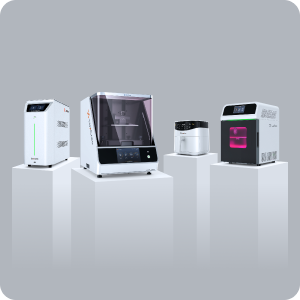
iLux Pro Dental Printer represents the pinnacle of desktop dental 3D printing technology. This desktop DLP printer delivers industrial-grade performance in a compact footprint (less than 45 inches of table space). Equipped with LuxCreo’s proprietary LEAP™ (Light Enabled Additive Production) platform and Digital Polishing™ technology, the iLux Pro Dental directly prints FDA-cleared aligners requiring zero manual polishing. The system achieves 80% higher transparency than competing solutions and reduces polishing labor by 75%.
The printer supports 23+ dental resins through optimized material partnerships and features 1-Click AI-automation workflow that eliminates complex technical decisions. Resolution reaches 3840 x 2160 ppi with 50 µm pixel pitch, enabling exceptional detail. Build volume of 192 x 108 x 200mm suits chairside and lab applications while maintaining desktop portability.
LuxCreo’s software ecosystem deserves particular emphasis:
- LuxDesign automatically generates aligner shell models from orthodontic treatment plans, eliminating manual design labor
- LuxFlow Dental provides one-click support generation, orientation optimization, and slicing for 11+ dental indications with 23+ resin workflows
- LuxCloud Dental integrates cloud-based monitoring, design services, and production management
4D Aligner™ represents LuxCreo’s innovation in aligner technology. This FDA-cleared system incorporates ActiveMemory™ shape-memory polymer, delivering superior force consistency, improved patient comfort, and reduced attachment requirements. The multi-thickness design creates force variations precisely controlling tooth movement stages.
LuxCreo’s overall approach emphasizes total solution provision—hardware, software, materials, and post-processing devices designed as an integrated ecosystem rather than disparate components.
SprintRay: Established Chairside Excellence
SprintRay Pro 2 dominates the established chairside printing market. This DLP printer has earned recognition as the gold standard for in-office dental applications, combining exceptional speed with sophisticated cloud-based software integration.
The Pro 2 prints standard models in approximately 30-40 minutes with exceptional reliability. Print speed adjusts based on material and application requirements, with validated presets for crowns, models, guides, and restorations. The build platform fits 2-3 full arch models, suiting chairside batch printing.
SprintRay’s ecosystem particularly impresses through cloud integration. The cloud design platform offers AI-powered design optimization, automatic margin detection, and integrated professional design services accessible to everyday practitioners. ProWash and ProCure systems complete the workflow, automating post-processing and minimizing manual labor.
Material compatibility spans their proprietary resin library plus validated third-party materials, including KeySplint Soft. This flexibility enables practitioners to optimize material selection for specific applications rather than compromising clinical outcomes for printer compatibility.
SprintRay MIDAS represents 2024’s industry breakthrough. This novel printer introduces press-printing technology—applying selective pressure during printing to optimize resin flow and cure characteristics. Early results suggest MIDAS may enable direct printing of definitive restorations with strength and esthetics rivaling lab-milled alternatives. While commercial availability remains recent, initial reception suggests this innovation may fundamentally shift chairside restoration approaches.
Formlabs: Reliability and Elegance
Form 3B+ built Formlabs’ reputation as the accessible entry point for dental 3D printing. This SLA printer delivers exceptional reliability and user-friendly operation at $10,000, including complete wash and cure systems—an attractive value for practices new to 3D printing.
Form 3B+ features generous build platform (145 x 145mm), enabling printing 8+ models simultaneously. While SLA technology runs slower than DLP systems (models require 60-90 minutes), the machine reliably achieves advertised print times without calibration complications.
PreForm software earns consistent praise for intuitive operation and professional-quality support generation. Cloud printing management enables remote job monitoring and queuing. The dental version provides additional features optimizing common dental applications.
Form 4B represents Formlabs’ newest generation, building on proven Form 3B+ architecture with improved speed and reliability. Enhanced optics reduce print times while maintaining exceptional surface quality.
Formlabs material selection emphasizes validated, reliable resins over maximum flexibility. The approach appeals to practitioners prioritizing predictability over choice, though material options remain more limited than open-system alternatives.
Ackuretta: Speed and Value Innovation
SOL delivers exceptional speed through advanced LED technology and innovative monochromatic LCD design. This printer achieves three times faster printing than conventional LCD systems through superior LED power delivery (5 mW/cm² versus 1 mW/cm² for standard systems). Dynamic LED auto-selection enhances accuracy while extending LCD panel life.
SOL supports 150+ validated resins on its completely open platform, providing maximum material flexibility. The printer offers multiple build plate sizes (large, medium, small), enabling users to optimize print speed based on part requirements. Medium platform prints full arch applications flat in approximately 25 minutes; small platform prints 5-7 crowns in 15 minutes.
Dentiq serves budget-conscious practices with reliable, straightforward DLP printing at approximately half SOL cost. While slower than SOL, Dentiq offers exceptional value for practices prioritizing economy over speed.
Asiga: Proven Laboratory Workhorse
Max UV remains one of the most popular lab 3D printers despite its age. This DLP system serves thousands of dental labs worldwide, known for exceptional reliability and the industry’s largest material library (500+ validated materials).
Max UV’s open system enables access to virtually any dental resin, particularly valuable for labs needing specialized materials (Lucitone denture resins, custom experimental materials). The extensive material validation database ensures consistent, predictable printing across diverse resin options.
Reliability deserves particular emphasis—Asiga’s SPS (Substrate Positioning System) provides platform positioning feedback, ensuring Z-axis accuracy with every layer. Real-time LED power adjustment automatically compensates for light variations, optimizing cure consistency throughout lengthy production runs.
Build platform (119 x 67mm) suits lab batch printing of multiple cases. Print speed ranges from adequate to slow, depending on material and application, but the machine produces exceptional accuracy consistently.
Conclusion: The Future of Digital Dentistry
Dental 3D printing has transcended early-adopter status to become an essential component of modern dental practices. The technology has matured substantially, offering multiple pathways for different practice models, treatment philosophies, and investment capabilities.
Success requires matching printer capabilities to specific clinical applications, understanding workflow integration opportunities, and viewing the system as a total solution rather than isolated equipment. The most sophisticated practitioners combine direct-print technology (aligners, guides, surgical applications) with flexible material options supporting diverse clinical needs.
Leading brands now offer solutions addressing every practice size and budget level. Entry-level LCD systems provide accessible entry into 3D printing workflows. Desktop DLP printers enable same-day chairside applications. Industrial-scale systems handle high-volume laboratory production. Each category has evolved substantial maturity and reliability.
As materials continue advancing (novel denture resins, gradient-stiffness aligners, biocompatible implant components), as AI design optimization matures, and as resin economics continue improving, 3D printing will penetrate deeper into routine dental workflows. Practitioners who embrace this transformation now position themselves to deliver superior patient outcomes, increase operational efficiency, and differentiate their practices in an increasingly competitive marketplace.
The ultimate guide to dental 3D printers recognizes that the “best” printer depends entirely on your specific applications, workflow preferences, and business model. By systematically evaluating technology, understanding applications, and matching solutions to needs, you position yourself to successfully integrate this transformative technology into your practice or laboratory.
This article is partly based on publicly available information and relevant technical literature. It has been compiled and analyzed by our team for learning and communication purposes only.
Subscribe to Our Newsletter
Be the first to get our latest updates and free trials!
Popular Resources




Follow Us


Featured Products
4D Aligner™
First Smart ActiveMemory™
Aligner
iLux Pro Dental Solution
Ultimate 1-Click Dental
Application Solution
LuxCloud Dental
Your One-stop Digital Dentistry
Platform