






What Is The Difference Between Direct-Printed Aligners And Thermoformed Aligners?
Clear aligner therapy has revolutionized orthodontics, offering patients a discreet and comfortable alternative to traditional braces. However, the method used to manufacture these aligners significantly impacts their effectiveness, cost, and sustainability. Two primary manufacturing approaches dominate the market: thermoformed aligners, which have been the standard since their FDA clearance in 1998, and direct 3D printed aligners, an innovative technique that received its first FDA clearance in 2022. This comprehensive guide explores the key differences between these two technologies and how they’re reshaping the future of orthodontic care.
Understanding the Two Technologies
Thermoformed Aligners: The Established Standard
Thermoformed aligners have been the industry standard for over two decades. The manufacturing process begins with creating a physical or digital impression of the patient’s teeth. Treatment planning software then generates a series of digital models showing incremental tooth movements, typically 0.25mm per aligner. These digital models are 3D printed, and then the critical step occurs: transparent plastic sheets—commonly made from materials like PETG or TPU—are heated and vacuum-formed over each printed model. The aligners are then manually trimmed and finished before delivery to patients.
This indirect approach involves multiple manufacturing steps that have become well-established within the dental industry, providing practitioners with a familiar and proven workflow that has shaped clinical expectations for decades.
Direct 3D Printed Aligners: The New Frontier
Direct 3D printed aligners represent a paradigm shift in aligner manufacturing. Rather than creating physical models and thermoforming plastic sheets over them, this technology eliminates the model entirely. Instead, biocompatible photopolymer resins are directly 3D printed layer by layer using digital light processing (DLP) technology to create the final aligner. This means the aligner goes directly from digital design to finished product in a single manufacturing step, without any intermediate thermoforming process.
LuxCreo achieved a significant milestone by receiving the first FDA clearance for direct print aligners in 2022, introducing their ActiveMemory™ polymer, a revolutionary material engineered specifically for this application. This technology enables dental practices to complete the entire workflow—from patient scan to finished aligner—in just 2-3 hours, enabling same-day treatment starts.
Manufacturing Process and Workflow Efficiency
The manufacturing differences between these two approaches have profound implications for clinical workflow and operational efficiency.
Thermoformed Workflow
The thermoformed process is labor-intensive and time-consuming. After treatment planning, the workflow requires:
- 3D printing of dental models
- Manual block-out creation
- Heating and vacuum-forming plastic sheets over models
- Manual trimming and finishing
- Quality control checks
- Often multiple refinements due to fit or accuracy issues
This multi-step process typically requires 2-4 weeks for delivery, especially when outsourced to a laboratory, as it involves printing, thermoforming, trimming, and shipping delays. Additionally, the manual steps—particularly trimming and block-out creation—are susceptible to human error and require skilled expertise.
Direct Printing Workflow
The direct printing process is streamlined and largely automated:
- Intraoral scanning captures patient dentition
- Treatment planning software generates tooth movement sequences
- AI-driven LuxDesign software automatically creates optimized aligner shells with one click, including gap filling, trimline adjustments, and customized thickness
- LuxFlow software automatically handles model orientation and support generation
- Direct 3D printing using biocompatible resin
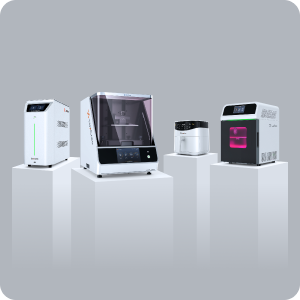
- Automated washing with iLuxWash Dental
- UV post-curing with iLuxCure Pro
- Same-day patient delivery
The entire process takes approximately 2-3 hours from initial scan to finished aligner ready for patient insertion. This dramatic reduction in time enables chairside production with minimal manual intervention, reducing labor requirements from 5.5 minutes per aligner in traditional workflows to just 1.5 minutes with direct printing.
Material Performance and Clinical Effectiveness
Perhaps the most significant difference between these technologies lies in their material properties and how they maintain orthodontic force over time.
Thermoformed Plastic Limitations
Conventional thermoformed aligners suffer from inherent material science challenges:
Permanent Deformation: Under the constant, warm, moist environment of the mouth, thermoformed polymers like PETG undergo irreversible creep. The polymer chains gradually shift positions, causing the aligner to lose its shape and force delivery capability over time.
Uncontrolled Thickness Variation: The thermoforming process creates significant thickness inconsistencies. When plastic stretches over a dental model, thinner areas develop—particularly on taller teeth or curved surfaces. A clinical study documented that 0.75mm plastic sheets varied between 0.38-0.69mm after thermoforming. Since a 10% reduction in thickness can reduce exerted forces by up to 30%, these variations dramatically compromise force delivery accuracy.
Force Degradation: Thermoformed aligners typically exert high initial force followed by rapid decay, creating a cycle of patient discomfort and inefficient tooth movement.
Water Absorption: Hydrolysis weakens the structural integrity over time, accelerating deformation and reducing clinical efficacy.
ActiveMemory™ Polymer: A Superior Alternative
LuxCreo’s ActiveMemory™ polymer (AMP) addresses these limitations through innovative materials science:
Consistent Force Delivery: Unlike thermoformed materials, ActiveMemory™ polymers maintain a stable elastic modulus with less than 10% variation between 37°C (body temperature) and 25°C (ambient temperature). This ensures consistent, predictable force delivery throughout the wear cycle.
Precise Thickness Control: Direct 3D printing enables dimensionally controlled differential thickness, where specific areas can be programmed to exact specifications. This allows clinicians to create customized force zones for individual anatomical requirements, dramatically improving force application accuracy compared to the thickness variations inherent in thermoforming.
Shape and Force Recovery: A groundbreaking feature of ActiveMemory™ polymers is their ability to “remember” their original shape and force capability. If an aligner undergoes minor deformation during wear, patients can simply soak it in hot water (above 60°C) to restore both its geometric shape and mechanical properties. This thermal activation restores aligners to “like-new” conditions with full force recovery, and can be repeated multiple times across the aligner’s lifespan.
This mechanism works because ActiveMemory™ polymers feature a hard component that maintains structural rigidity across temperatures and a soft component that enables reversible deformation. This dual-mechanism design decouples intraoral mechanical stability from post-removal thermal restoration—a fundamental advantage over conventional shape memory polymers that soften significantly at body temperature.
Accuracy and Patient Outcomes
Accuracy is paramount in orthodontic treatment, directly affecting patient comfort and treatment efficiency.
Dimensional Accuracy Comparison
Direct 3D printed aligners demonstrate superior dimensional accuracy. Clinical data shows that direct printed aligners achieve approximately 96.25% accuracy within ±0.1mm tolerances, compared to thermoformed aligners at around 75.07% accuracy with ±0.2mm tolerances. This 20% accuracy improvement translates directly to better fit, improved patient comfort, and more predictable tooth movement.
Clinical Implications
The superior accuracy and consistent force delivery of direct printed aligners with ActiveMemory™ polymers deliver measurable clinical benefits:
- Reduced Refinement Needs: Better initial accuracy and consistent force delivery minimize the need for mid-course corrections and additional aligner sets
- Shorter Treatment Duration: Maintained optimal forces and continuous movement capability can accelerate treatment timelines
- Fewer Attachments Required: Precise force control often eliminates or significantly reduces the need for auxiliary attachments, improving aesthetics and reducing complexity
- Enhanced Predictability: Digital design with precise thickness control enables clinicians to tailor force application to individual anatomy, improving tooth movement predictability
Cost Considerations
Cost analysis reveals compelling advantages for direct printing, particularly for in-house production.
Equipment and Infrastructure
Thermoformed aligner production requires:
- 3D printer
- Thermoforming machine
- Thermoplastic sheets
- Dental handpieces and cutting tools
- Dedicated manufacturing space
- Specialized trained staff
Direct printing requires:
- 3D printer (compact desktop model)
- Post-processing equipment (washing and curing)
- Resin materials
- Design and slicing software
- Significantly smaller facility footprint
- Minimal staff training needs
Per-Aligner Fabrication Costs
Direct printed aligners from LuxCreo cost approximately $6 per aligner in fabrication costs with $50 software cost per case, compared to traditional chairside thermoforming approaches at $10-12 per aligner fabrication costs.
For a patient requiring 30 aligner pairs:
- Direct printing: $410 total ($6 × 30 + $50 software)
- Thermoforming: $770 total ($10-12 × 30 + $50 software)
This represents a 47% cost savings with direct printing, a significant advantage that improves with scale. Additionally, direct printing eliminates outsourcing fees and shipping delays when production occurs in-house.
Sustainability and Environmental Impact
Environmental consciousness increasingly influences manufacturing decisions in healthcare.
Waste Generation
Thermoformed aligners generate considerable plastic waste:
- Entire plastic sheets must be purchased and cut, with the majority becoming waste
- Dust and particulates from manual polishing and trimming create workplace hazards
- Physical models must be printed for each sequential aligner, creating substantial resin waste
- Larger facility footprint requires more energy consumption
Direct printed aligners dramatically reduce environmental impact:
- Only the resin needed for the actual aligner is used
- Minimal to no waste generation
- No dust or particulate concerns—production occurs in a clean environment
- Smaller footprint requires less energy
- No physical models required
This aligns with the growing demand for sustainable manufacturing practices in modern dentistry.
Patient Experience and Comfort
Patient satisfaction represents a critical measure of treatment success, and these technologies differ significantly in their patient-facing advantages.
Treatment Initiation Speed
With thermoformed aligners, patients typically wait 2-4 weeks from consultation to treatment initiation. This delay can reduce case acceptance rates and patient motivation. Direct printing enables same-day aligner delivery—patients can begin treatment within hours of their initial scan. This immediate gratification significantly enhances patient engagement and treatment compliance.
Aligner Comfort
ActiveMemory™ polymers provide superior patient comfort through:
- Optimal initial force magnitude (avoiding the excessive discomfort of thermoformed aligners)
- Consistent force delivery throughout the wear cycle
- Smooth, polished edges requiring no manual trimming
- Superior optical clarity providing better aesthetics
- Maintenance of mechanical properties preventing the looseness that develops with thermoformed aligners
The daily thermal restoration capability also provides a hygiene advantage—patients can simply soak their aligners in hot water to both clean and rejuvenate them, ensuring each aligner feels fresh and effective.
Challenges and Considerations
While direct printed aligners offer substantial advantages, practitioners should understand the current landscape and considerations.
Technology Maturity
Thermoforming has established protocols, widespread industry familiarity, and decades of clinical evidence. Direct printing is newer, though recent FDA and CE clearances, along with emerging clinical studies, are building practitioner confidence.
Material Options
Currently, biocompatible clear resins for final 3D-printed aligners are more limited than thermoforming plastic sheet options. However, as the market expands, material choices will increase.
Regulatory Compliance
Direct printing requires adherence to specific validation protocols, including FDA 510(k) clearance and ISO 13485 quality management standards. Practitioners must follow validated equipment, software, and material combinations to ensure biocompatibility and effectiveness.
Implementation Requirements
Successful adoption requires:
- Training on digital scanning and planning
- Understanding of direct printing workflow
- Proper post-processing protocols
- Quality control measures
- Integration into existing practice systems
The Future of Clear Aligner Therapy
The trajectory is clear: direct 3D printing represents the future of clear aligner manufacturing. Several emerging developments will further advance the technology:
AI-Driven Optimization: Advanced algorithms will continuously analyze cases, auto-tune print parameters, and predictive maintenance needs, requiring minimal operator input.
Multi-Material Printing: Future innovations may enable gradient stiffness aligners or integrated attachments printed in a single process, further reducing complexity.
Tele-Orthodontics Integration: Remote monitoring platforms combined with direct printing will enable virtual check-ins and data-driven treatment modifications.
Expanded Applications: The same technology producing aligners is enabling production of retainers, night guards, and other orthodontic appliances, creating comprehensive chairside solutions.
Conclusion
The distinction between direct-printed aligners and thermoformed aligners represents more than a manufacturing difference—it’s a fundamental shift in how orthodontic treatment is delivered. While thermoformed aligners established clear aligner therapy as an orthodontic standard, direct 3D printing with ActiveMemory™ polymers offers superior accuracy, consistency, cost-effectiveness, and sustainability.
Direct printed aligners enable same-day treatment initiation, reduce refinement needs, improve patient comfort, lower costs by 47%, and minimize environmental impact. With FDA clearance, emerging clinical evidence, and growing practitioner adoption, direct printing is rapidly becoming the preferred choice for forward-thinking practices seeking to enhance patient outcomes while improving operational efficiency.
For practices considering whether to adopt this technology, the evidence is compelling: direct printed aligners represent the next evolution in clear aligner therapy, offering measurable benefits that impact every aspect of orthodontic care delivery.
Subscribe to Our Newsletter
Be the first to get our latest updates and free trials!
Popular Resources




Follow Us


Featured Products
4D Aligner™
First Smart ActiveMemory™
Aligner
iLux Pro Dental Solution
Ultimate 1-Click Dental
Application Solution

LuxCloud Dental
Your One-stop Digital Dentistry
Platform