






Summary of Dr. Kelvin's Webinar Course Highlights
Topic: Overcoming the force-decay limitations of traditional plastic through ActiveMemory™ polymers and Hybrid Treatment.

Dr. Kelvin Chang, DDS, MS
Dr. Kelvin Chang, DDS, MS
- Chairman of Education Committee, Taiwan Association of Orthodontists
- Associate Editor, APOS Trends in Orthodontics
- Advisor, World Implant Orthodontic Association
- Adjunct Clinical Instructor, Orthodontic Department, National Taiwan University Hospital
- Private Practice, Hsinchu, Taiwan
- DDS, MS Degree, National Taiwan University, Taipei, Taiwan
Dr. Kelvin Wen-Chung Chang is a leading orthodontist and educator recognized across Asia for his innovative approach to integrating digital technology into orthodontic treatment. With extensive academic and clinical experience from National Taiwan University, Dr. Chang has been a pioneer in adopting direct 3D printing technologies for orthodontic applications, particularly in clear aligner treatment. His current focus lies in developing workflows that leverage ActiveMemory™ Polymer (AMP)—a revolutionary 4D innovative material that allows aligners to respond to external stimuli dynamically, optimizing treatment accuracy and efficiency.
1. The Clinical Challenge: The "Thermoforming Ceiling"

Despite the popularity of clear aligner therapy (CAT), orthodontists frequently hit a "performance ceiling" dictated by the manufacturing process, not their own skill1. Dr. Kelvin Chang identifies three critical mechanical failures inherent to traditional thermoformed aligners:
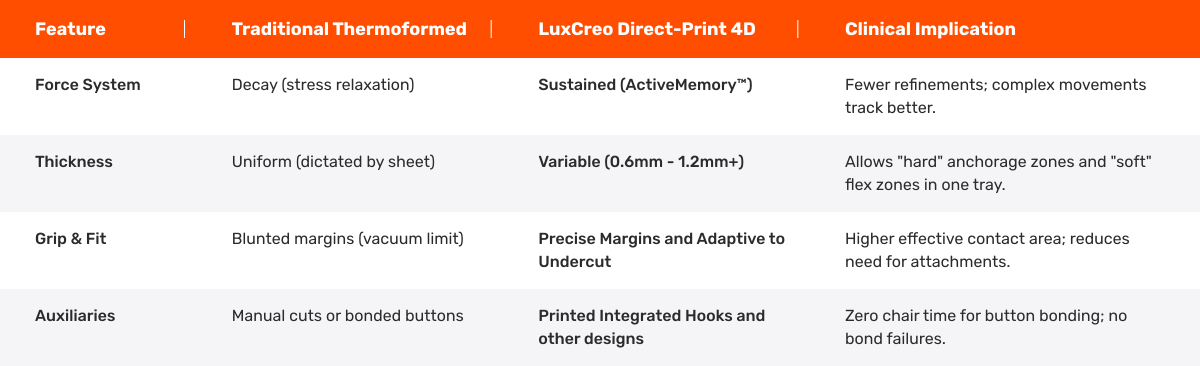
- Rapid Force Decay: Traditional plastics suffer from significant stress relaxation. They lose their force delivery capabilities rapidly after insertion, often failing to complete the programmed movement.
- Geometric Inaccuracy: The vacuum-forming process dulls sharp edges and precise features. It is impossible to imprint precise force vectors (like deep undercuts or specific intrusion ramps) because the heated plastic slumps over the model.
- Reliance on Attachments: Because the tray itself lacks grip and stiffness control, clinicians are forced to bond excessive composite attachments to achieve retention and torque, increasing chair time4.
The Goal: A "Dream Aligner" that combines the aesthetics of CAT with the light, continuous force and elastic memory of an orthodontic wire.
2. The Solution: LuxCreo Direct-Print 4D Aligners™

Dr. Kelvin transitioned to LuxCreo’s direct-print ecosystem to utilize ActiveMemory™ polymers. This is not standard 3D printing; it represents a fundamental shift in material science.
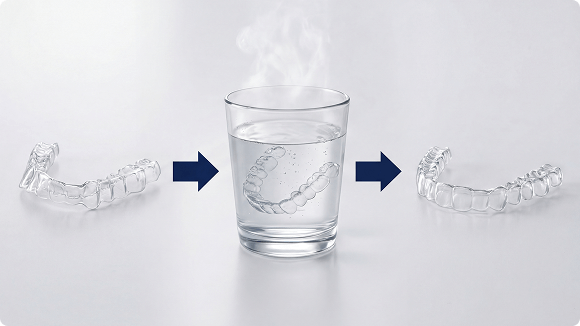
A. 4D Biomechanics (ActiveMemory™ - Beyond Shape Memory)
Unlike passive plastic, this material has true shape memory. When the aligner deforms or loses retention, the patient can immerse it in hot water. The material recovers its original printed geometry and force levels.
- Clinical Benefit: Ensures consistent force delivery throughout the wear cycle, preventing the "tracking lag" common in difficult rotations7.

B. Variable Thickness & Integrated Mechanics
Direct printing frees the clinician from uniform thickness.
- Targeted Stiffness: The software can thicken the aligner significantly in posterior anchorage segments while keeping anterior segments thinner for comfort or flex.
- Built-in Auxiliaries: Hooks for Class II/III elastics, bite ramps, and pontics are printed as one continuous unit. They are not glued on; they are structural, reducing breakage and bonding appointments.
3. Clinical Application: Hybrid Treatment Protocols

Dr. Kelvin advocates for a Hybrid Approach—combining the strengths of fixed appliances and direct-print aligners to treat complex malocclusions efficiently.
Case 1:
The "Sequential" Hybrid (High-Angle Bimax)
Patient Profile: 35 year-old female, high-angle, needing lower molar protraction, pre-molar derotation and lower incisor intrusion to flatter the curve.bimax and severe protrusion, 25 large decay.
The Problem: Patient insisted to use aligner treatment.
The Protocol: Sequential hybrid approach. Extracted second premolars. Started with sectional fixed appliances to retract the first premolars and uprighting lower molars. Then transitioned to direct-print aligners with build-in buttons, mini-screws, and elastics for finishing.Upper Arch: In-house Direct-Print Aligners (for aesthetics and best leverage clear aligner capability).

Outcome: Successfully combined modalities to make a non-ideal aligner case manageable, achieving the desired retraction and space closure.

Case 2:
Non-Surgical Molar Intrusion (Direct-Print Mechanics)
Challenge: Supra-erupted maxillary molar (#26) opposing a missing mandibular molar. Traditional aligners struggle to grip and intrude molars without "squeezing" them out of the aligner (the watermelon seed effect).

Direct-Print Solution:
- Designed integrated Buttons on aligners with rubber band to have bilateral intrusive force without the need for TADs.
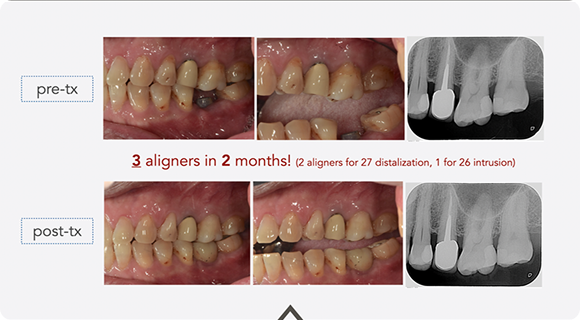
Utilized the customized Trimline & Local-thickening to reinforce the aligner, achieving 1.55mm intrusion with a single tray step in 5 weeks. Furthermore, the ActiveMemory™ material ensured that aligner retention was well-maintained throughout treatment.
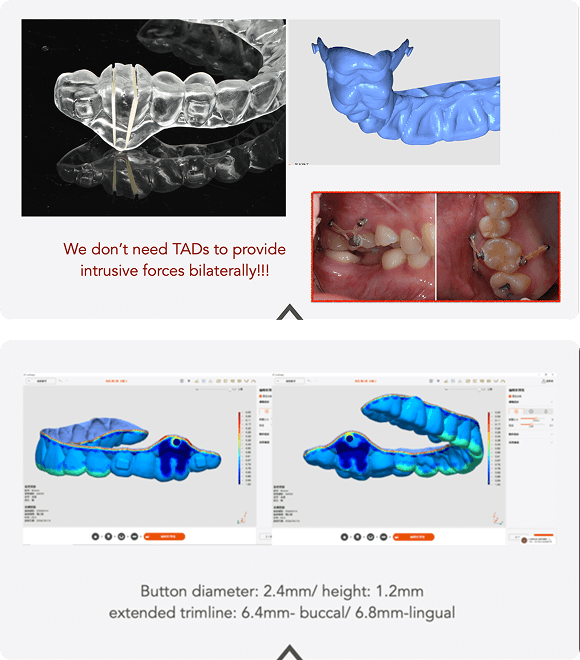
Outcome: Successful intrusion was achieved using only three aligners without the application of TADs, resulting in reduced treatment duration and high patient satisfaction.
4. Comparative Analysis: Thermoformed vs. Direct-Print


5. Conclusion: The "In-House" Revolution
Dr. Kelvin’s success demonstrates that moving production in-house is not just about cost—it is about control.
By adopting LuxCreo’s workflow, orthodontists can:
- Eliminate the "Middleman" Delay: Design and print aligners immediately.
- Customize Mechanics: Design force systems (like bodily retraction or intrusion) that commercial vendors often reject or fail to execute.
- Ensure Stability: Use materials with high Heat Deflection Temperature (HDT) that survive the oral environment without distorting.
The Verdict: The future of orthodontics is not in better plastic sheets; it is about transforming clear aligner treatment from shape-driven to force-driven. By creating a true orthodontic biomechanical force system that leverages various tools—including direct-printing and braces—clinicians can ultimately deliver better treatment to their patients.it is in printing smart, responsive, and variable-geometry appliances that mimic the biomechanics of fixed braces.