






Variable Thickness Aligners: Transforming Orthodontic Precision with LuxCreo
Orthodontic treatment has entered a new era of precision and comfort through the advent of multi-thickness aligners, leveraging direct-printed technology and advanced polymers. By varying aligner tray thickness across treatment zones, LuxCreo’s solution offers predictable force delivery, enhanced patient comfort, and streamlined workflows, setting a new standard over uniform-thickness and thermoformed appliances.
Introduction
Clear aligners revolutionized orthodontics by replacing metal brackets with discreet, removable trays. However, traditional thermoformed aligners, produced by heating and molding plastic sheets over a dental model, suffer from uniform and uncontrollable thickness that cannot tailor force magnitude or duration to specific teeth, leading to unpredictable movements and patient discomfort. The search intent behind “multi-thickness aligners” (customized aligner thicknees tailored to each tooth) reflects both clinicians’ desire for customizable biomechanics and patients’ demand for more comfortable treatment.
Biomechanical Rationale for Variable Aligner Thickness
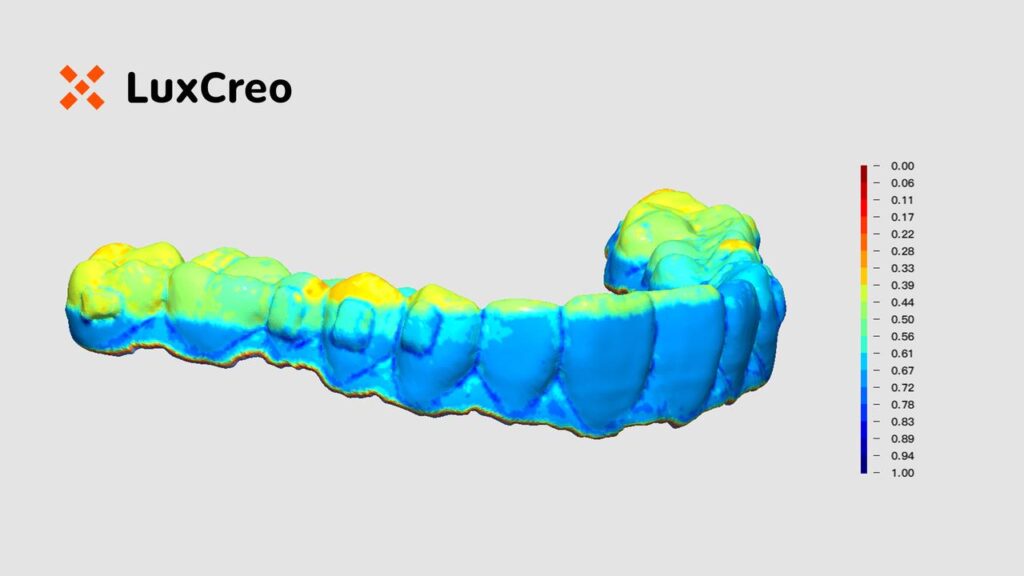
Aligner thickness directly influences both the magnitude and consistency of forces applied to teeth. Thicker regions deliver higher initial force but can accelerate force degradation, while thinner sections offer gentler loads yet risk insufficient movement. By programming variable thickness gradients, stress concentrates precisely where needed, ensuring consistent activation over time and uniform stress distribution across the arch. This tailored approach mitigates the risk of uncontrolled tipping and enhances treatment predictability.
Technology Enabling Multi-Thickness Design
Unlike thermoforming, direct 3D printing builds aligners layer by layer, enabling high -level control of material deposition. Advanced CAD software integrates thickness-mapping algorithms that assign discrete thickness zones—for example, thicker in root-movement regions, thinner at gingival margins for comfort. Automated block-out functions and optimized trim-line generators ensure each aligner fits undercut anatomy while preserving programmed thickness patterns.
LuxCreo’s Multi-Thickness Aligner Solution
Central to LuxCreo’s technology is ActiveMemory™ polymer, a shape-memory resin engineered for superior force sustainability and reversible deformation across varied thicknesses. Its high elastic recovery ensures trays consistently rebound to their original designed geometries, delivering precise forces even after repeated wear cycles. Clinicians can define custom thickness maps—for example, adding 0.2 mm in canine torque regions and reducing 0.1 mm around molars—to optimize biomechanics. A single thermal reactivation step restores polymer memory, ensuring each aligner achieves its intended properties regardless of thickness variation.This material, combined with direct 3D printing technology, allows for 1:1 precision in reproducing designs, ensuring that every aligner is crafted exactly as intended with perfect accuracy.
Clinical Benefits
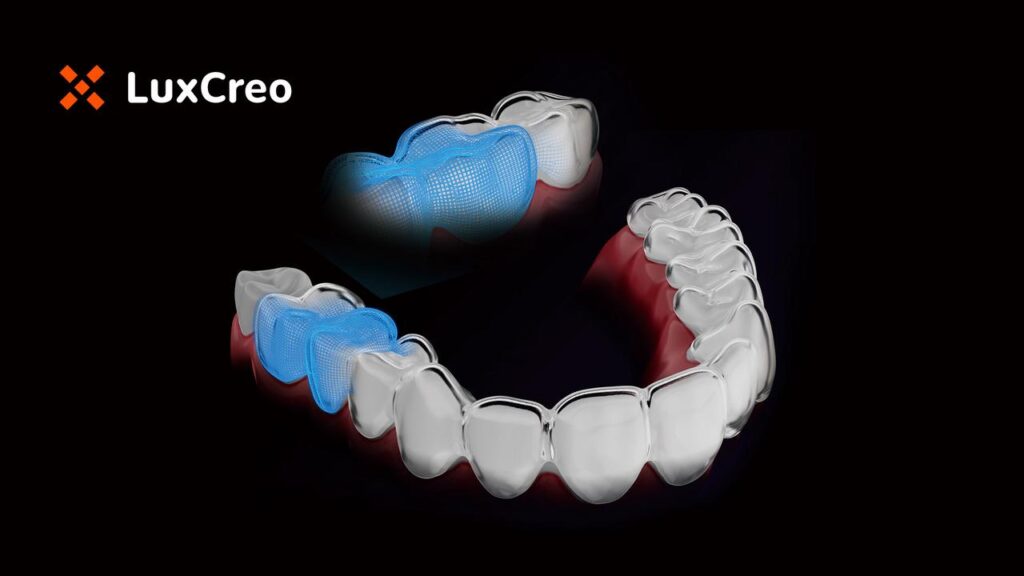
Variable-thickness aligners enable targeted force control: incisors receive gentler, sustained pressure, canines benefit from enhanced rotational moments, and posterior teeth maintain anchorage. Patients experience reduced discomfort in sensitive gingival zones thanks to gradual stiffness. Furthermore, precise force staging diminishes the need for attachments and mid-course refinements, shortening treatment duration and lowering overall aligner count.
What’s more, combining with customized aligner thickness, aligners can have better tooth movement (bodily movement) according to the plan.
Bodily movement refers to the ability to move the entire tooth—root and all—within the bone, rather than just shifting the crown. This type of movement is crucial for more complex orthodontic cases, where teeth need to be repositioned significantly.
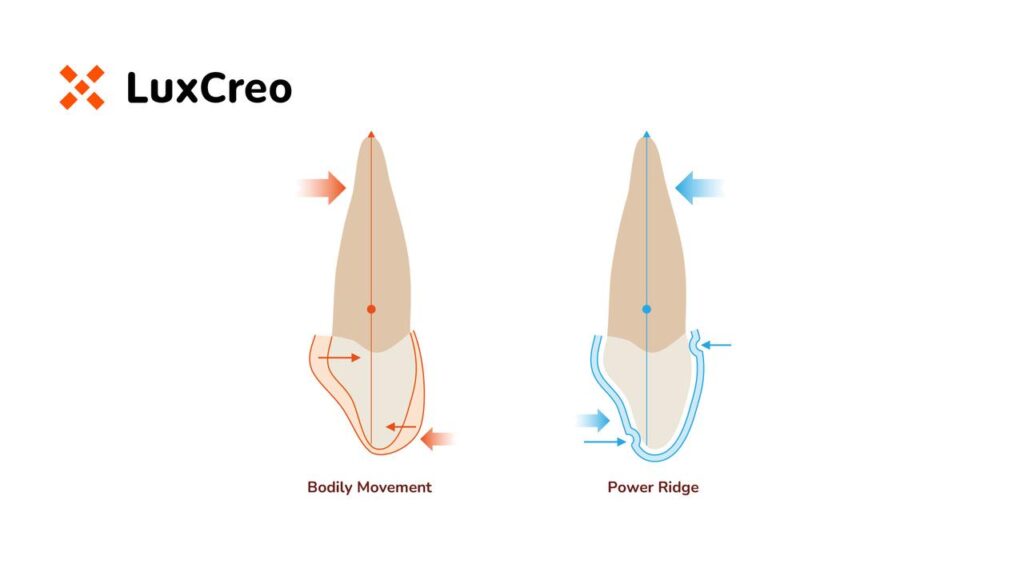
By adjusting the thickness of specific areas of the aligner, orthodontists can apply the precise amount of force required to initiate bodily movement in different teeth, ensuring they move in the most efficient and controlled way. This allows for better overall alignment, improves the occlusion, and ensures that the desired results are achieved with minimal discomfort for the patient. The ability to control bodily movement through customized aligner thickness also reduces the need for additional attachments, providing a more streamlined and aesthetically pleasing treatment experience.
Workflow Integration
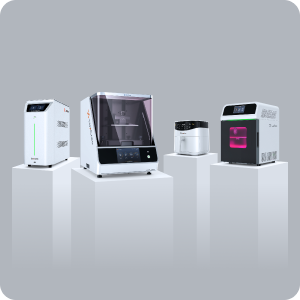
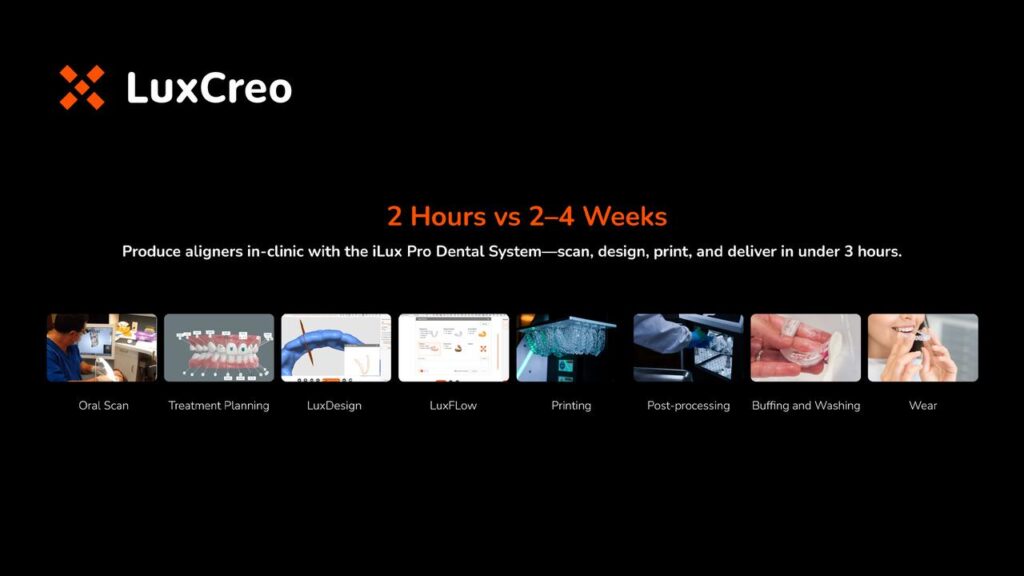
LuxCreo’s scan-to-print ecosystem streamlines multi-thickness production. Intraoral scans are imported into LuxDesign™ software, where AI-driven modules generate thickness gradients based on planned movements. The iLux Pro Dental Pro™ printer fabricates aligners chairside within minutes, followed by standardized post-processing in LuxWash™ and LuxCure™ units.
Get all the details of the workflow:https://luxcreo.com/printers/ilux-pro-dental/
Case Studies and Outcomes
No Attachment to Solve Lower Incisor Root Torque Issue
A female adolescent in permanent dentition underwent a 7-month treatment with 4D Aligner™ to correct a lower incisor positioned too far facially, presenting a Class I malocclusion and root torque issue. Her aligners featured a multi-thickness design without any attachments: additional thickness was applied at the anterior tooth neck, generating targeted pressure on the gingival one-third buccal and incisal one-third lingual surfaces to reposition the root. After seven months of wear, the undesirable torque was fully resolved without using attachments.
For more real-world applications and results, explore our clinical case studies.

Future Directions and Innovations
The future of multi-thickness aligners will focus on advancing the aligner thickness customization and optimization of tooth movement. As the technology evolves, AI-driven optimization will refine the design of aligners, offering even more precise gradients of thickness based on a patient’s specific malocclusion type. This will allow clinicians to adjust the force applied to each tooth with even greater accuracy, further improving treatment outcomes, while reducing treatment times and enhancing the overall patient experience.
Looking forward, multi-thickness aligners will expand into new clinical areas, such as lingual appliances and 3D-printed retainers, extending personalized biomechanics beyond traditional aligner treatments. With continued advancements in shape-memory technology, aligners could activate secondary force stages without the need for new sets, making treatment more efficient and comfortable. As these technologies mature, we can expect even more individualized and dynamic treatment plans, pushing the boundaries of orthodontic care toward faster, more effective, and highly personalized solutions. LuxCreo will collaborate with more clinicians and clinics, engaging in clinical trials to further refine and validate these advancements.
Conclusion
Multi-thickness aligners represent a paradigm shift in patient care, combining direct-printed manufacturing, smart polymers, and software intelligence to deliver tailored orthodontic biomechanics. LuxCreo’s leadership with ActiveMemory™ polymer and integrated digital workflows ensures clinicians can provide predictable, efficient, and comfortable treatments—empowering better outcomes for patients worldwide.
Subscribe to Our Newsletter
Be the first to get our latest updates and free trials!
Popular Resources




Follow Us


Featured Products
4D Aligner™
First Smart ActiveMemory™
Aligner
iLux Pro Dental Solution
Ultimate 1-Click Dental
Application Solution

LuxCloud Dental
Your One-stop Digital Dentistry
Platform