





How New Shape-Memory Resins Are Changing the
Future of Direct-Printed Aligners
February 4, 2026
This blog is based on the findings from the newly published paper by Dr. Jean-Marc Retrouvey, Asian Pacific Orthodontic Society: Assessment of active memory of photo-curable resins for LuxCreo DCA direct-printed 3D aligners
Introduction

A recent materials study conducted by Dr. Jean-Marc Retrouvey evaluated two photo-curable resins used for LuxCreo’s direct-printed aligners: DCA and DCA Plus. Researchers wanted to understand whether these materials could offer stronger, more predictable performance than traditional thermoformed aligner plastics. Their tests focused on three areas:
- Thermomechanical stability (how the materials behave at different temperatures)
- Shape memory performance (how well they recover their original shape)
- Force retention and recovery (whether they maintain orthodontic forces over time)
The findings point to clear advantages for shape-memory printed aligners — especially compared to conventional plastics used for thermoforming.
Why Thermoformed Aligners Have Limits
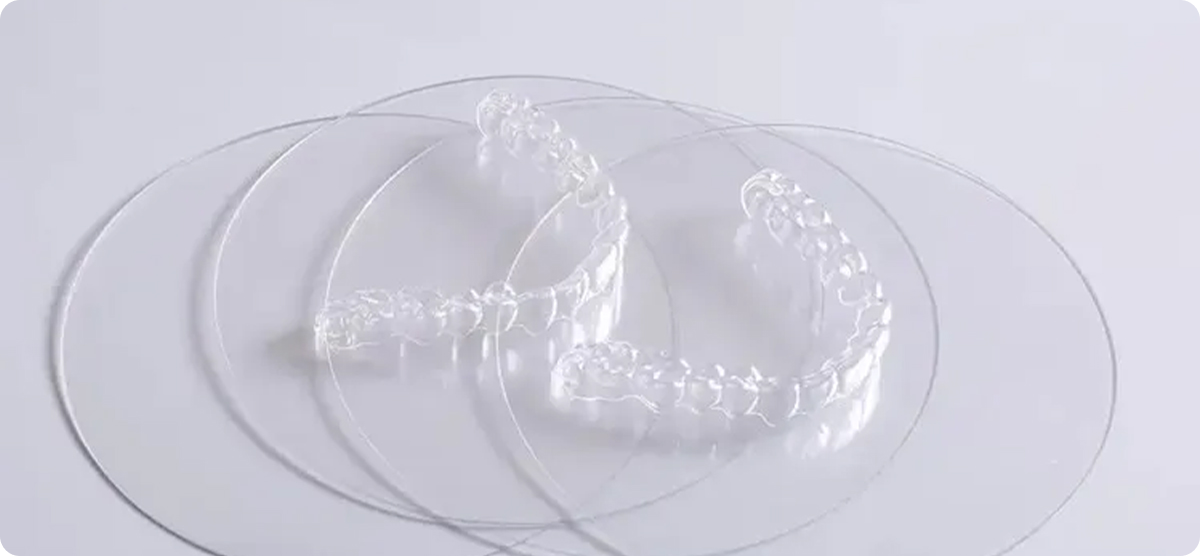
Thermoformed aligners like PETG and polyurethane have been the standard for decades, but they come with well-documented drawbacks:
- They deform permanently over time, especially with heat, biting pressure, or water absorption.
- They lose force quickly, meaning the force planned in treatment planning software often doesn’t match what’s happening in the mouth.
- They rely heavily on attachments because the plastic lacks the elasticity needed to grip and move teeth predictably.
- Complex movements often aren’t achieved, requiring revisions and additional aligners.
This is why researchers and manufacturers have begun exploring shape-memory polymers — materials that can return to their original designed shape and maintain force longer.
What This Study Looked At
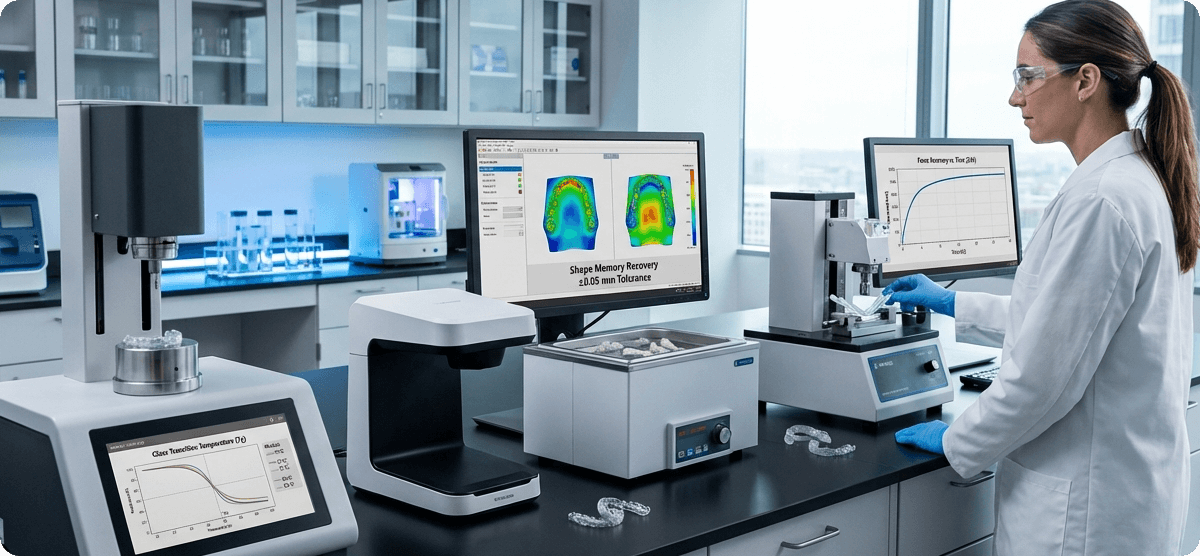
Researchers printed aligners and testing samples using LuxCreo’s DCA and DCA Plus materials, then ran a series of evaluations:
1. Thermomechanical Analysis (Tg and Modulus Testing)
To see how the materials handle temperature changes, they measured:
- Glass transition temperature (Tg)
- Modulus changes at room temperature, mouth temperature (37°C), and high heat
2. Shape Memory Performance
Printed aligners were:
- Scanned in their original state
- Heated, soaked, and physically deformed
- Then exposed to boiling water to trigger shape recovery
- Compared against their original scan with ±0.05 mm and ±0.1 mm accuracy tolerances
3. Force Restoration
Bent samples and aligners were stressed for 24 hours, then thermally activated to see if their force-output returned to its original level.
Key Findings
High Thermomechanical Stability

The results of the study concluded that DCA and DCA Plus possess exceptional stability and strength recovery, with both materials exhibiting unusually high glass transition temperatures.
DCA: 118°C
DCA Plus: 130°C
This means they remain strong, stable, and resistant to deformation in everyday conditions. Even at mouth temperature (37°C), their stiffness shrank only slightly (8–10%), ensuring predictable forces during treatment.
Remarkable Shape Memory Performance
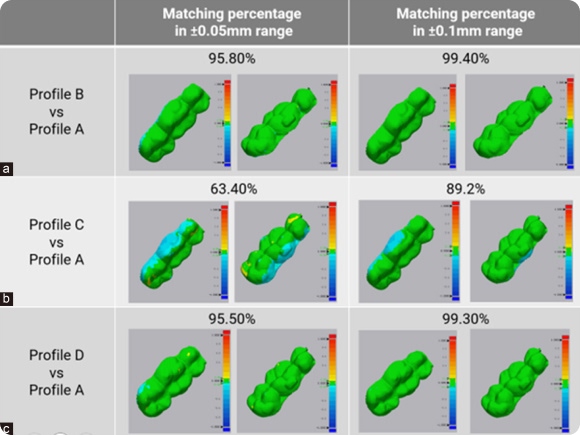
DCA Plus demonstrated near-perfect recovery:
- 95.8% within ±0.05 mm tolerance
- 99.4% within ±0.1 mm tolerance
Even after being bent for 24 hours, DCA Plus aligned itself back to its intended geometry once heated.
Thermoformed aligners exposed to boiling water would permanently deform — but direct-printed aligners retained rigidity and accuracy.
Reliable Force Recovery
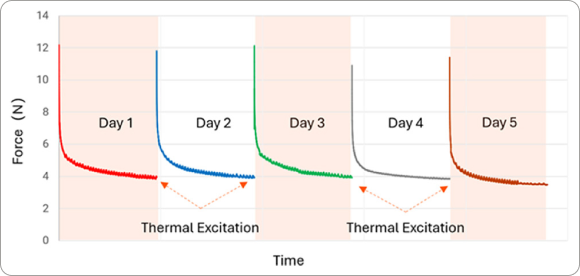
When the material’s force naturally decayed from being bent, a simple thermal activation restored it:
- Mechanical properties fully recovered
- Repeated cycles didn’t weaken the material
This confirms that printed aligners can re-engage and continue applying controlled, consistent force long after they’ve been worn.
Why This Matters for Orthodontics
The study suggests that direct-printed aligners made from shape-memory resins like DCA and DCA Plus could meaningfully improve treatment efficiency and predictability in orthodontics. Because these materials maintain their shape and force over time far better than thermoformed plastics, clinicians may see fewer mid-treatment setbacks, fewer refinements, and potentially shorter treatment durations overall.
Their ability to grip tooth geometry more precisely also means many movements can be achieved with fewer or no attachments, simplifying both the clinical workflow and the patient experience. Combined with the sustainability and speed benefits of eliminating resin models, these materials position direct printing as not just a technological upgrade, but a meaningful clinical improvement with real impact on outcomes, chair time, and patient satisfaction.
Conclusion
The study concludes that LuxCreo’s DCA and DCA Plus resins provide:
- High thermal stability
- Strong shape-memory behavior
- Excellent force retention and recovery
- Superior geometric stability
- Clear advantages over thermoformed plastics
If future clinical trials further back these findings, direct 3D printing — especially with high-performance SMP materials like DCA Plus — could become the new standard for clear aligner therapy.